How an Ambiguous Photograph Turns Into Evidence
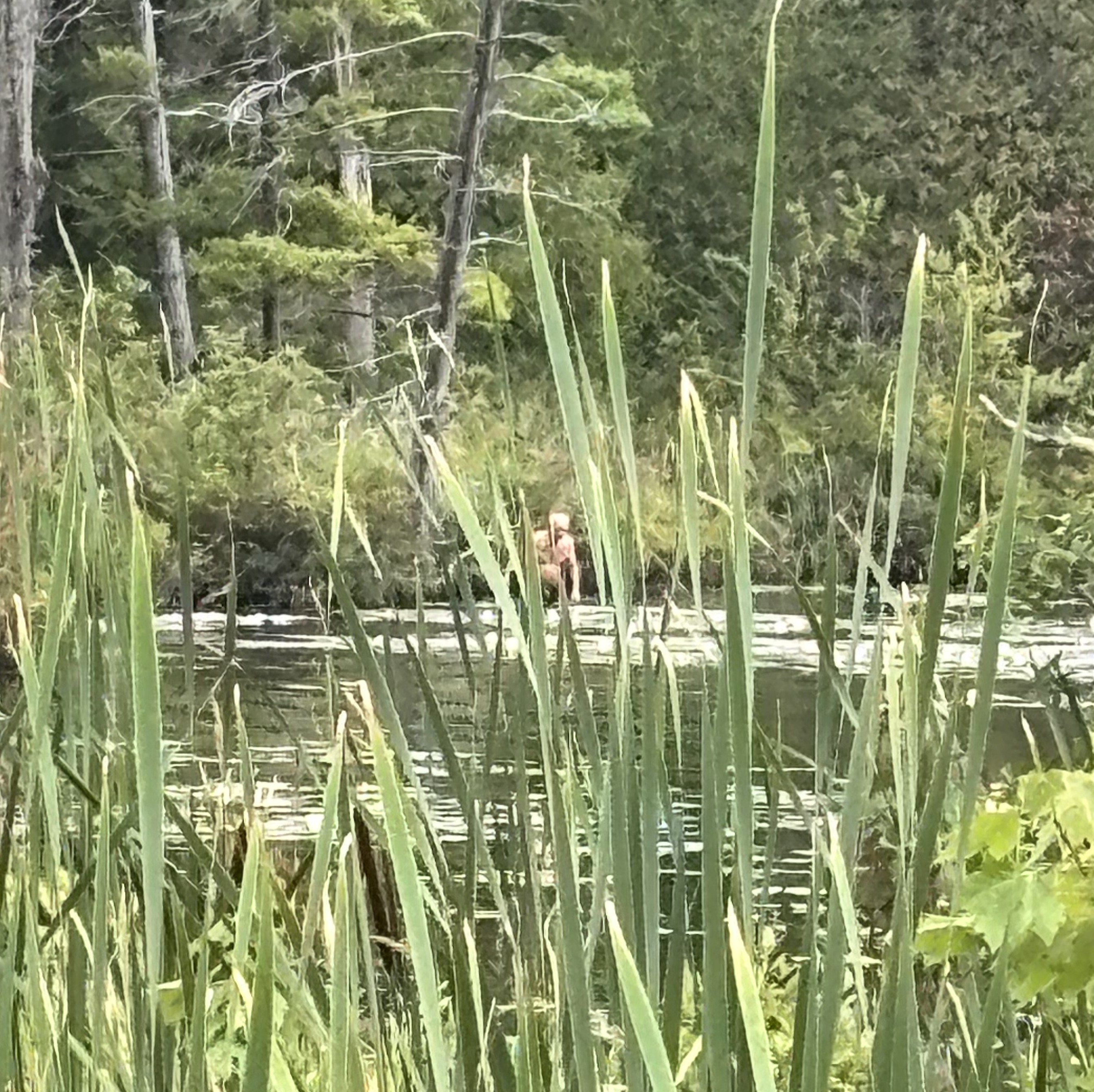
Take a good look at the photograph before you read anything about it. Don’t look for someone else’s explanation. Just look at the figure standing in the water and decide what you think you’re seeing. Is that a person or Bigfoot? Are you sure?
I’ll tell you what I saw. I saw a person. Maybe a shirtless person, maybe a naked person, although the photograph isn’t clear enough to tell what’s happening below that rather substantial belly. They could be wearing dark swim trunks for all I know. Whatever the answer, my first thought wasn’t Bigfoot.
Apparently, I wasn’t alone. The photograph was taken on August 10, 2026, near Syracuse, New York, by a woman identified only as K.D. She had gone hiking on her day off and made her way toward a glacial pond. When she spotted something standing in the water roughly 240 feet away, her first impression wasn’t a cryptid either. She thought someone was wading in the pond.
K.D. took a couple of pictures, and in the second, the figure appeared to turn toward her. That made her uncomfortable enough to leave the area. Later, when she looked more closely at the photographs, the figure began to look strange to her. She showed the pictures to a friend, and the friend immediately thought Bigfoot. That’s where things started to change.
The photographs eventually reached Bigfoot researchers, but even then, the human explanation didn’t immediately disappear. One investigator described his first impression as an elderly, out-of-shape naked man. Matthew Moneymaker, founder of the Bigfoot Field Researchers Organization, also initially considered the possibility that he was looking at a naked man. But before Moneymaker ever saw the photographs, he heard about a figure wading in a swampy pond and thought, “That is bigfoot behavior.”
That sentence bothers me, not because Bigfoot couldn’t wade into a pond. If Bigfoot exists, I assume it can get wet. What bothers me is what happens when an explanation enters the room before all the evidence does. Once Bigfoot is already sitting at the table, everything that comes afterward can start looking a little different.
The pond itself became part of the argument. The area was described as remote and difficult to access. An investigator later waded into the pond while attempting to recreate where the figure had been standing and encountered submerged branches, roots, mud and vegetation. It certainly doesn’t sound like a pleasant place to take an afternoon swim, but nobody said the person had to be swimming for fun.
There were hiking trails, a parking area and signs. Another family was arriving to hike while K.D. was leaving. This wasn’t some untouched patch of wilderness where the presence of a human being demanded an extraordinary explanation. Someone could have been camping and cleaning up, living rough, cooling off, skinny-dipping or doing something else entirely. For that matter, we can’t even tell from the photograph whether the figure is completely naked.
None of those possibilities proves it’s a person. They do show how easy it is to make something sound mysterious by asking why a person would possibly be there while ignoring perfectly ordinary reasons someone might be. We don’t know why the figure was standing in the pond because we don’t know who or what the figure was. That’s supposed to be the question we’re trying to answer.
Then investigators returned to the location six days later and attempted to reconstruct the photograph. Using the investigator’s six-foot height and objects visible in the scene for comparison, they estimated the mysterious figure at around four feet nine inches tall. That’s interesting, but it’s also an estimate dependent on recreating where another figure had been standing six days earlier, along with camera position, distance, posture and terrain. I wouldn’t bet much money on four feet nine, being the figure’s actual height.
Suppose they’re right, though. A four-foot-nine Bigfoot creates an obvious problem because Bigfoot is generally described as an enormous creature, often seven feet tall or more. Finding out your suspected Bigfoot is shorter than the average American woman should at least weaken the hypothesis. Instead, the hypothesis changed. Maybe it was a juvenile.
That’s where this stopped being a Bigfoot story for me. The evidence didn’t fit the expected Bigfoot, so the Bigfoot got smaller. What looks like exposed skin might actually be light-colored wet fur. Apparent human anatomy could be Sasquatch anatomy distorted by distance and poor resolution. Even changes in the figure’s appearance between photographs could potentially be explained by wet fur hanging differently as it moved.
Could all of that be true? Sure. A juvenile Bigfoot isn’t impossible if Bigfoot exists and reproduces. Wet fur can change appearance, distance can distort proportions, and a creature that lives outdoors could certainly wade through difficult terrain. The problem isn’t that any one of those explanations is impossible. It’s that every time something doesn’t fit the hypothesis, another explanation appears that allows the hypothesis to survive.
Move the goalposts far enough and eventually you can score from anywhere on the field.
Confirmation bias is usually described as our tendency to favor information that supports what we already believe. That’s true, but I think that definition misses the more interesting part of what happens. Sometimes we don’t just favor evidence that agrees with us. We become remarkably creative when explaining away evidence that doesn’t.
Before long, we’re no longer asking which explanation best fits what we’re looking at. We’re asking how we can make what we’re looking at fit the explanation we’ve already chosen. There’s an important difference between those two questions, even if we don’t realize we’ve switched from one to the other. The second one can keep almost any belief alive indefinitely.
Of course, it’s easy to see confirmation bias when somebody else is doing it. It’s considerably harder when I am, and I told you at the beginning that I looked at the Syracuse photograph and immediately saw a person. Maybe I’m doing exactly the same thing.
A person makes sense to me. The figure looks human. People use ponds, camp, bathe outdoors and ignore signs telling them not to enter the water. Short people exist, and dark swim trunks could disappear against the water in a photograph taken from 240 feet away. I can build a perfectly reasonable explanation around a person standing in that pond, but reasonable isn’t the same thing as proven. I don’t know that it’s a person.
That’s where skepticism can fall into exactly the same trap as belief. If I decide beforehand that Bigfoot doesn’t exist, then no photograph can ever show Bigfoot. No footprint can ever belong to one, and no witness can ever have seen one. Every piece of evidence must have another explanation because I’ve already decided what the answer cannot be. At that point, I’m moving my own goalposts.
I’ve spent enough time around paranormal subjects to know how tempting certainty can be. Believers want something to be real, while skeptics want something to have an explanation. Either position can become more comfortable than admitting the evidence has left us stranded somewhere in the middle. Sometimes the most accurate answer really is that we don’t know.
What interests me is how quickly we can turn what we think we see into what we know we see, then start rearranging everything that follows until it agrees with us. I have no problem saying I don’t know what that figure is. I think it’s a person, and I could be wrong. There simply isn’t enough in those photographs for me to know.
What bothers me more is how often we don’t stop there. How many times have we judged before knowing, settled on an answer because it fit what we already believed, then moved the pieces around when they didn’t quite fit? How many mysteries have believers declared paranormal and skeptics declared solved when the most honest answer was sitting there the entire time?
We don’t know.
Leave a Reply