What Happens When You Check the Story?
There was an underground nuclear test detonated in China in 1992. The resulting seismic waves from that explosion traveled thousands of miles. Then scientists used them to study what may be under the Alaskan surface.
That much is not speculation. The nuclear test happened on May 21, 1992, at China’s Lop Nor testing site, and seismic stations across North America recorded it. Scientists later used those waves to study structures deep beneath Alaska. What happened somewhere between those two facts and a local television newscast in Anchorage is where this story gets interesting.
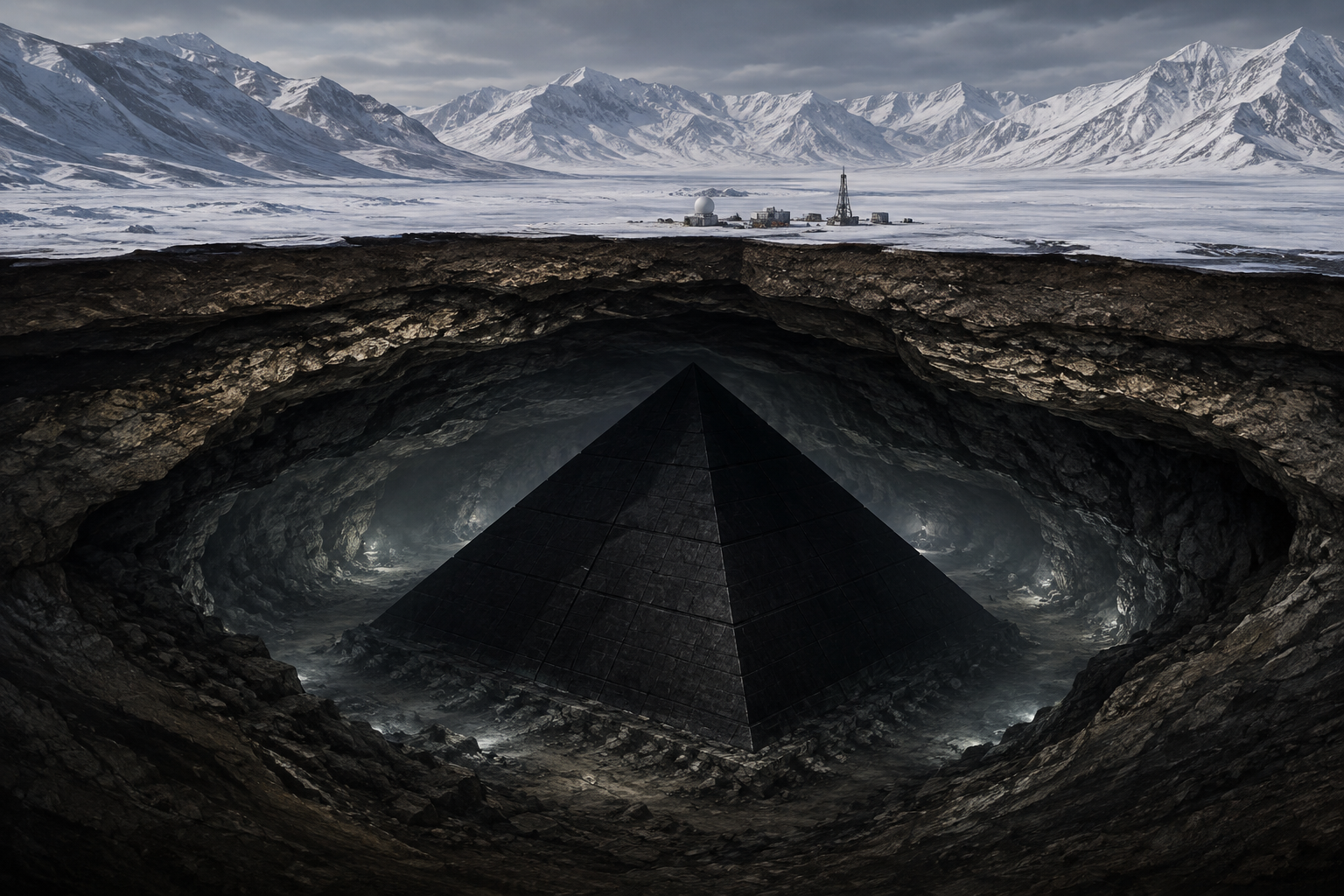
One of the people who says he saw that newscast was Douglas Mutschler, an Army counterintelligence officer stationed at Fort Richardson. Mutschler said he was in the orderly room sometime in late November or early December when a local Channel 13 news report began talking about the Chinese nuclear test. According to him, the report explained that geologists had used seismic information from the explosion to get a better picture of the Earth’s crust and mantle. Then came the part nobody has been able to verify. Mutschler said the report announced that a massive pyramid had been discovered beneath Alaska, larger than the Great Pyramid of Giza.
He remembered more than a reporter simply mentioning it. Mutschler said the report included graphics showing the scale of the structure and a map indicating its location. There were other soldiers in the orderly room, although that detail has grown considerably in some retellings. Having nearly forty men in an Army orderly room does not mean nearly forty men were sitting quietly watching television. People work there, come and go, talk, handle paperwork, and ignore whatever happens to be playing in the background. What matters is that Mutschler says he was watching, and he says some of the other soldiers saw it too.
I first covered the Black Pyramid years ago in Episode 24 of 4 Ever Paranormal. It was a much broader look at the story, and I already knew many of the claims that had accumulated around it. Over time, the Black Pyramid became connected to extraterrestrials, secret underground facilities, advanced technology, enormous power sources, and even stories similar to those surrounding Dulce. Eventually there was so much piled on top of the original account that it became difficult to tell where the actual story ended and everything added later began.
I have always thought there might be something there. What I had never done was go back and strip away everything that came later, then check the original story one piece at a time. That’s where this took a turn I wasn’t expecting, because some of the things that sound suspiciously convenient in Mutschler’s account aren’t convenient at all. They actually happened.
China really did conduct a major underground nuclear test at Lop Nor in May 1992. Estimates vary on its yield, but it was China’s largest nuclear test to that point. An underground explosion of that magnitude sends seismic energy through the Earth, and those waves were detected thousands of miles away. There is nothing unusual about that part. Nuclear tests had long been monitored seismically, both for scientific purposes and because knowing when another country detonated a nuclear weapon was obviously of considerable interest to the United States.
The part that matters here is what scientists did with those waves. USGS seismologists John Vidale and Harley Benz used seismic data from that specific Chinese explosion to investigate structures beneath Alaska. Their work eventually identified a previously unknown anomaly deep beneath northern Alaska near the core-mantle boundary. It was not the Black Pyramid. Their anomaly was thousands of kilometers below the surface and vastly larger than anything Mutschler described.
Vidale and Benz aren’t evidence that the pyramid exists, and I don’t think they need to be. Their importance to this story is much narrower. They prove that seismic waves from the exact nuclear explosion Mutschler remembered really were being used to look beneath Alaska, and scientists really did find something previously unknown while doing it. One of the most peculiar pieces of his story suddenly has a documented scientific foundation.
That still leaves a rather large problem. If an Anchorage television station aired a report announcing the discovery of a giant underground pyramid, where is it?
Mutschler said he wondered the same thing almost immediately. He went back to his room and programmed his VCR to record the next newscast, expecting the story to run again. It didn’t. He later contacted the station looking for the report and said management denied it had ever aired. According to Mutschler, someone at the station privately told him otherwise, saying the report had aired but the material had been removed. We have no way to verify that conversation today, and nobody has produced the original broadcast.
That missing broadcast is the biggest hole in the story. Mutschler said that when he returned to his unit and told the other men that the television station denied airing the story, some reacted with disbelief because they remembered watching it. There is also at least one later account from another person claiming to remember the Channel 13 report. I don’t put much weight on that one because it surfaced years later, after Mutschler’s story was already circulating. It is interesting, but it isn’t the kind of independent corroboration that would settle it.
Another detail in Mutschler’s story predates the television report. He remembered seeing an area of Alaska whited out on a map in 1989. Three years later, when the news report supposedly displayed the location of the pyramid, he believed it corresponded with the same area he had noticed before.
That sounds suspicious until you start looking at old maps of Alaska. Areas identified as not having been surveyed in detail really did appear on government maps. Alaska is enormous, remote, and historically difficult to survey comprehensively, so a poorly detailed or blank area does not automatically indicate somebody was hiding something. At the same time, we don’t have the particular map Mutschler remembers seeing. We cannot say whether the area was blank because it hadn’t been properly surveyed, because information had been deliberately omitted, or because he interpreted something mundane differently years later. His map story remains exactly what it should be in this case: another piece that is interesting but inconclusive.
This is also why I think all the extraterrestrial material that eventually became attached to the Black Pyramid needs to be pushed aside. This story doesn’t need aliens to be interesting. I don’t need an underground power plant or secret cooperation with nonhuman beings. Those claims may be worth exploring elsewhere, but here they only bury the original question beneath another layer of speculation.
Take all of that away and we’re left with a surprisingly simple claim. An Army counterintelligence officer says he watched a local television report in 1992 announcing that seismic waves from a Chinese nuclear test had revealed an enormous pyramid beneath Alaska. We cannot verify the pyramid or find the broadcast, but we can check much of what surrounded his story. The Chinese test happened, its seismic waves were recorded across North America, those waves were used to study beneath Alaska, and scientists discovered previously unknown structures while doing it. None of those facts proves Mutschler saw what he says he saw, but each removes a reason to dismiss his story.
That’s where circumstantial evidence becomes interesting. People sometimes use the word circumstantial as though it means worthless, but it doesn’t. I’ve seen prosecutors win cases without the smoking gun everyone expects. You start looking at the pieces together, asking whether they support each other, whether they contradict each other, and how many “coincidences” you are willing to accept before the larger picture deserves serious consideration.
I don’t think we have enough to say there is a Black Pyramid beneath Alaska. We don’t have the original broadcast, a photograph, physical evidence, or a government document acknowledging that it was discovered. More of Mutschler’s surrounding story checks out than I expected. That doesn’t get us to proven, but I think it gets us considerably farther than ridiculous.
I don’t think we’ve reached the end of this story. Government records concerning UFOs and UAPs continue to be released, sometimes in enormous batches containing documents that were written decades ago. If the Black Pyramid was ever documented, I doubt the answer will arrive in a neatly labeled file announcing that there is a giant pyramid buried beneath Alaska. It may be hidden within the continuous release of UFO files, mentioned in a seismic report, intelligence memo, attachment, correspondence, or an obscure document whose importance isn’t recognized until someone connects it to this story.
Maybe that document doesn’t exist. Maybe the missing Channel 13 broadcast had a perfectly ordinary explanation, and Mutschler spent the next thirty years remembering something differently from what actually aired. Both possibilities have to remain on the table because we still don’t have the smoking gun.
But that’s no longer the only question I’m asking.
The nuclear test was real. The seismic waves were real. Scientists really used them to look beneath Alaska, and they really discovered things there that they hadn’t known about before. Mutschler told a story built around those events long before most people hearing about the Black Pyramid would ever bother checking whether the underlying details were true.
They are.
So just maybe the dominoes stack and it is there.
Leave a Reply