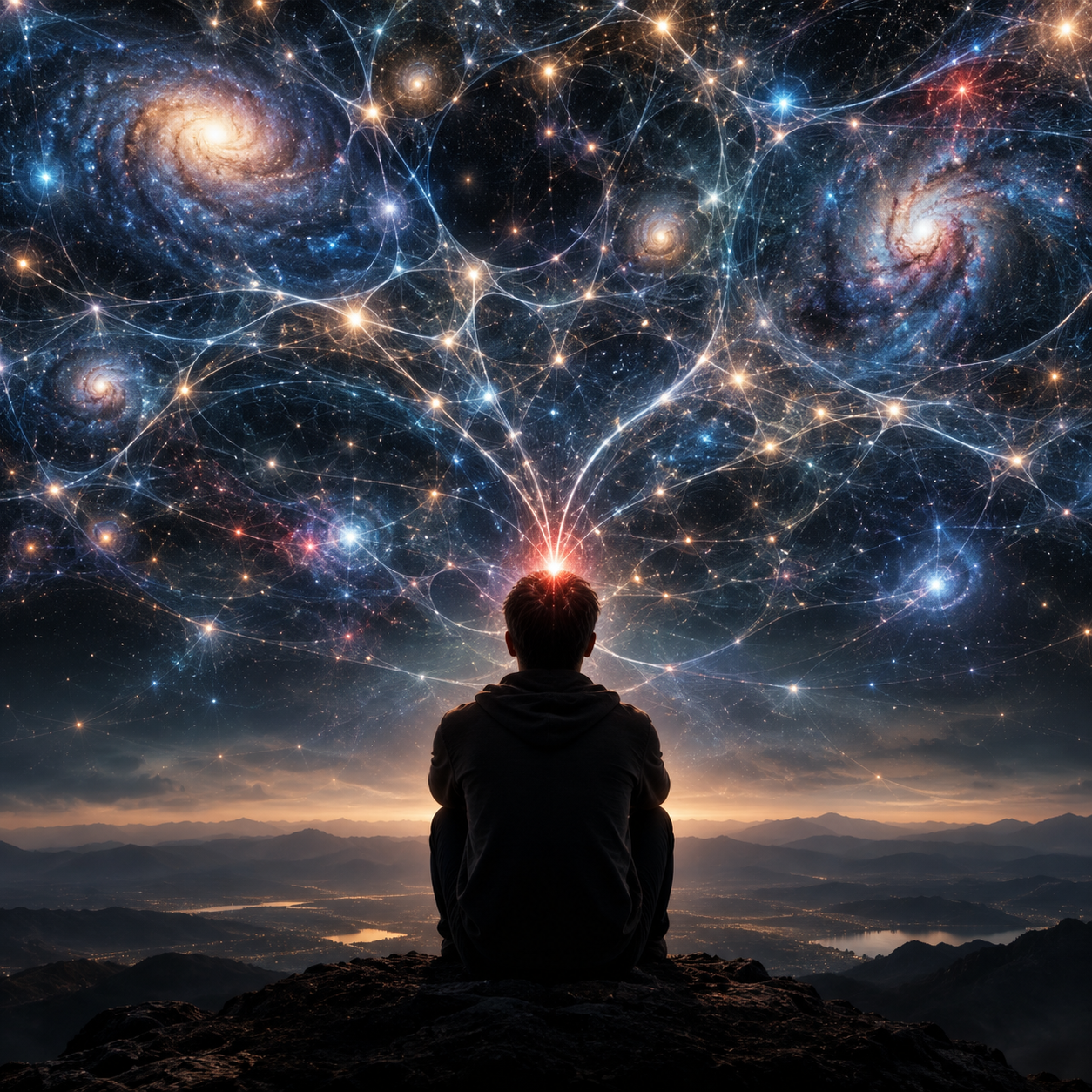
Part 1: Science Is Getting Closer to the Collective Consciousness
This is the first of a four-part series exploring what Robert Epstein’s Neural Transduction Theory might mean if we follow the idea beyond neuroscience. Over the next four parts, I’ll move from collective consciousness to the soul, our perception of time, and eventually the question at the center of all of it: What are we connected to?
***
Look at something red. A stop sign, an apple, a book cover, whatever happens to be nearby. You know it’s red. I know it’s red. But how do you know that the red you see inside your mind looks anything like the red I see inside mine?
We can measure the light entering your eyes. We know what the receptors in your eyes are doing, and we can follow the resulting signals into the brain. What we can’t do is climb inside your consciousness and see what you see. We both learned to point at that color and call it red, but that doesn’t necessarily mean your experience of red is identical to mine.
I’ve wondered about questions like that for a long time, especially when it comes to consciousness. Where does the physical process end and the actual experience begin? Every once in a while, I come across something that doesn’t give me a new idea so much as make me look differently at an old one. That’s what happened when I read about psychologist Robert Epstein’s Neural Transduction Theory.
Epstein is asking whether we’ve made a basic assumption about the brain that might not be right. We generally assume consciousness and intelligence are generated somewhere inside that three-pound mass of tissue in our skulls. Epstein proposes another possibility. What if the brain is also functioning as a transducer, connecting us to a source of information or intelligence that exists somewhere outside the brain itself?
My first thought was collective consciousness.
Robert Epstein is a research psychologist, and his idea is called Neural Transduction Theory. The basic premise isn’t difficult to understand. We already know the brain receives information from outside itself. Our eyes take in light, our ears pick up sound, and somehow those signals become the world we experience. Epstein is asking whether the brain might be doing something more, connecting to a source of information or intelligence that exists beyond the brain itself.
He calls that hypothetical source the OS, which can mean Operating System or Other Side. He doesn’t claim to know what it is, and he hasn’t proven that it exists. What caught my attention was how far he is willing to follow the possibility. Epstein and researcher Liancheng Zhao have considered whether the same basic connection might help explain things ranging from ordinary consciousness and dreams to genius, terminal lucidity, telepathy, claimed past-life memories, and even communication with the dead.
That is a pretty big leap, and there are scientists who think Epstein hasn’t provided nearly enough evidence to make it. Fair enough. Epstein says the theory can be tested, and that matters because eventually the evidence will either take us somewhere or it won’t. I don’t need Neural Transduction Theory to be right for the question behind it to fascinate me.
What happens if it is?
Not every detail. Not every phenomenon Epstein and Zhao have tried to fit into the theory. Just the central idea. Suppose the brain really is connecting to something beyond itself. The moment I considered that possibility, I wasn’t thinking about another dimension or trying to figure out which part of the brain might be doing the connecting. I was thinking about something I’ve believed could exist for a very long time.
Collective consciousness.
The term can mean different things depending on who is using it, so let me be clear about what I mean. I don’t picture eight billion human minds swimming around together in some enormous invisible cloud. I mean something more basic than that. There may be a larger source of consciousness or information that we are connected to while still remaining individuals.
We’ve spent most of our lives being told the information inside our heads belongs there. Your memories are yours because they happened to you. Your thoughts are yours because you thought them. Your experiences are stored somewhere in your brain, and when you need one, the brain finds it. That is such an ordinary way of understanding ourselves that most people probably never think to question it.
I have questioned it for a very long time. The possibility of collective consciousness, the Akashic Records, and information existing somewhere beyond an individual mind isn’t something Epstein introduced me to. What caught my attention was that he seemed to be approaching from neuroscience something I had been approaching from metaphysics and the paranormal for years.
His theory gave me a new way to ask an old question.
What if the brain doesn’t have to contain everything it can access?
That is a very different proposition. Your phone doesn’t contain the entire internet just because you can use it to read this article. The song coming through a radio isn’t stored inside the radio. Those devices give us access to information that exists somewhere else, and losing the device doesn’t erase the source. I’m not suggesting our brains literally work like phones or radios. I’m asking what changes if access and storage aren’t always the same thing.
Quite a lot, actually.
It would mean information could potentially exist independently of the individual brain experiencing it. Something could be available without being physically stored in the biological machinery between our ears. We might normally have access only to whatever belongs to our particular connection, which would explain why I don’t wake up knowing what you had for breakfast. But the larger information itself could still exist outside both of us.
That thought took me directly to the Akashic Records.
The idea comes from metaphysical and occult traditions and has been described in different ways over the years. At its simplest, the Akashic Records are supposed to contain information about existence and experience beyond what is stored in an individual human mind. People sometimes picture a great cosmic library, but I’ve never found the library image particularly useful. It makes something potentially enormous sound like a warehouse full of invisible books.
I’m more interested in the underlying idea.
Information exists somewhere, and under certain circumstances consciousness may be able to reach it.
Put that beside Epstein’s OS and something interesting happens. They aren’t the same concept, and I have no reason to pretend they developed from the same source. One comes from a modern scientific hypothesis and the other from metaphysical tradition. Yet both leave us staring at a surprisingly similar question: could information or intelligence exist beyond the individual brain while somehow remaining accessible to it?
Humans have been circling versions of that question for a very long time. Mystics described divine knowledge. Occultists developed ideas like the Akashic Records. Psychology gave us concepts of shared or collective aspects of mind. Religions spoke of unseen realms and sources of knowledge beyond ordinary human experience. Today Epstein is approaching the problem from an entirely different direction and asking whether the brain might connect to something outside itself.
Maybe none of them are describing the same thing.
But why have I always assumed they were?
We created the categories separating them. Science is over here. Religion is over there. Metaphysics gets another shelf, and the paranormal usually gets shoved into a closet until somebody hears footsteps upstairs. Those divisions help us study things, but nature doesn’t have to follow them. Something doesn’t become a separate part of reality simply because we gave it a different name.
That was the part of Epstein’s theory that stayed with me. Not the mechanics of neural transduction and not whether somebody eventually finds a particular place in the brain responsible for the proposed connection. It was the possibility that someone approaching consciousness through science might have stumbled onto a piece of something people approaching it through metaphysics have been talking about for generations.
Not proof. A possible piece.
That possible piece is where I want to leave this for now, because the next question is considerably larger. If individual consciousness really can connect to something outside the brain, then we have to ask where that information exists and what all those individual connections might lead to. That’s where collective consciousness begins running into another old idea, the Akashic Records, and where I started wondering whether both might be pieces of something much larger.
Leave a Reply