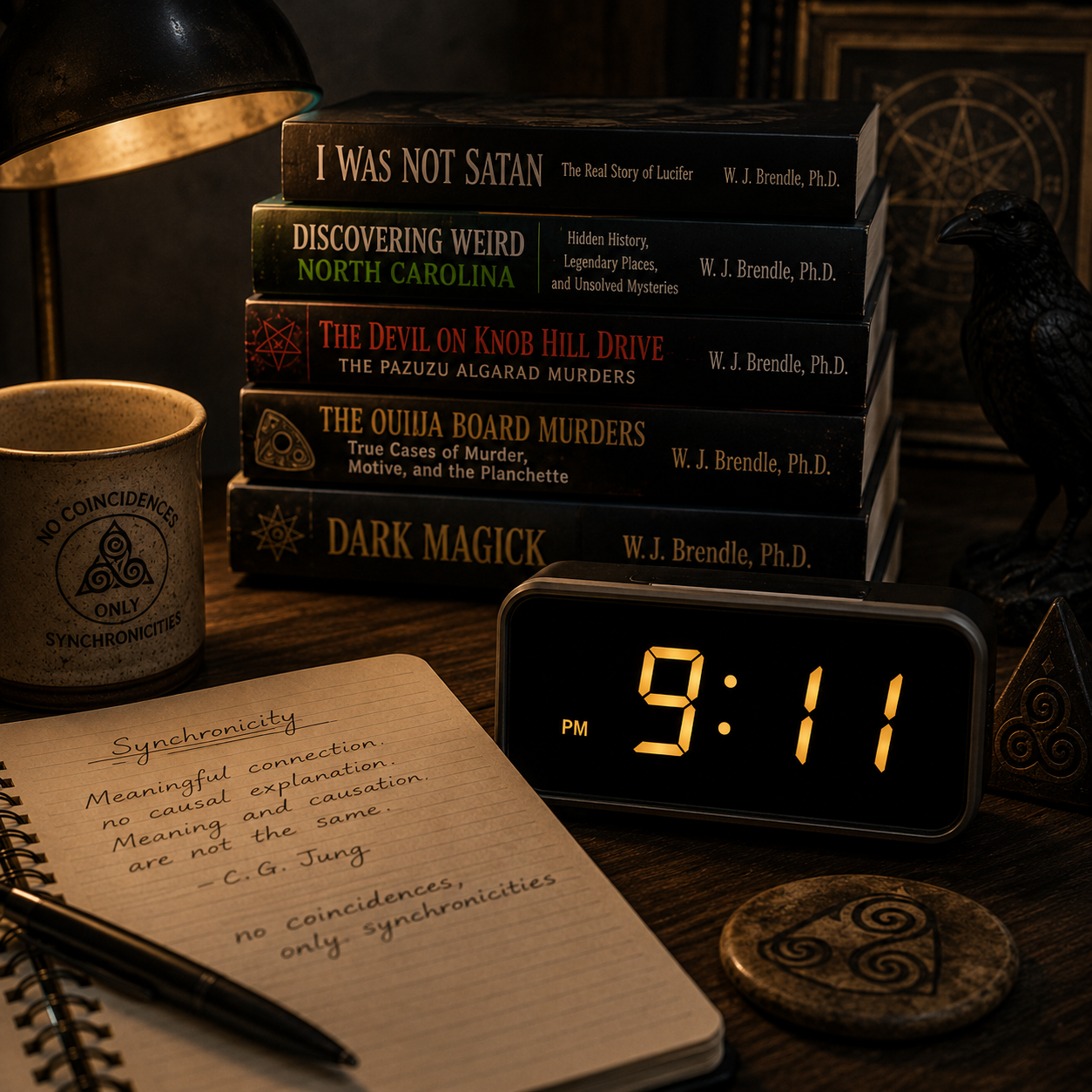
Synchronicity Is What You Felt
I don’t believe in coincidence. I haven’t for as long as I can remember.
Other people say it all the time. That can’t just be a coincidence. You can hear it in their voice when they say it, a small pause right before the sentence, like they’ve bumped into something bigger than they meant to touch. They mean it too, for that one breath. Then the next sentence arrives and hands them an exit. Coincidence. A word built for exactly one purpose, letting you feel something enormous and then set it back down like it weighed nothing at all.
I’ve never had that moment where I set it back down. I believe in synchronicity, and I think most people already do too, somewhere underneath the word they actually reach for.
Look up the real definition sometime, the dry one, the one nobody actually reads past the first clause. A coincidence is a remarkable concurrence of events with no apparent causal connection. Most people stop right there and hear what they already expected to hear. Random. Empty. Nothing behind it. Case closed, move on with your day.
But sit with the word doing the actual work in that sentence. Not “coincidence.” Apparent. The definition never says there’s no connection between two events. It only admits that nobody’s found one yet. That’s a far smaller claim than the one we’ve been quietly handing it our whole lives. We treat an honest shrug like a verdict. We treat “we haven’t traced it” like it means “there’s nothing there to trace.”
Carl Jung stood in that exact gap decades before any of us were saying it can’t just be a coincidence. Over coffee, in a hallway, in the dark at two in the morning when something lines up too well to let go of. He didn’t soften the idea into coincidence with feelings attached. He called it synchronicity, a meaningful connection between events with no causal explanation, and he didn’t hedge that definition the way we hedge ours. He simply said meaning and causation were never the same requirement to begin with, and you don’t need to prove the second one to be allowed the first.
That’s not a fringe idea some mystic invented out of thin air. That’s a serious mind looking at the same gap sitting in every dictionary and refusing to fill it with nothing, the way the rest of us do out of habit.
I live inside that gap now, most days without even noticing I’ve stepped into it. Numbers do it to me constantly. I’ll look at a clock and it’s 11:11, or 4:44, or 9:11, often enough that I stopped being able to call it chance a long time ago. I don’t read those as messages floating in from nowhere. I read them as my spirit guides confirming I’m on the right path, a kind of check-in on a decision I already made.
And that’s the part most people miss when they talk about synchronicity like it’s something that just happens to you. It doesn’t. Somewhere behind almost everything that shows up uninvited, there’s a choice that set it in motion. The thing that suddenly pops up demanding your attention usually traces back to something you already decided, or decided not to deal with, long before it arrived. Cause and effect doesn’t stop being cause and effect just because the gap between the two got wide enough that you forgot you were the cause. That’s what I mean when I say I don’t believe in coincidence. I believe every one of those numbers, every one of those moments, connects back to a decision that already belonged to me.
I’m not asking you to take my word for any of this. I’m asking you to take the dictionary’s word for it. Then notice how much smaller its actual claim is than the one you’ve been quietly living inside your whole life.
If any of this landed somewhere in you just now, that’s not a coincidence. That’s synchronicity, and now you know the difference.
Leave a Reply