What If We Aren’t the Only Ones Connected?
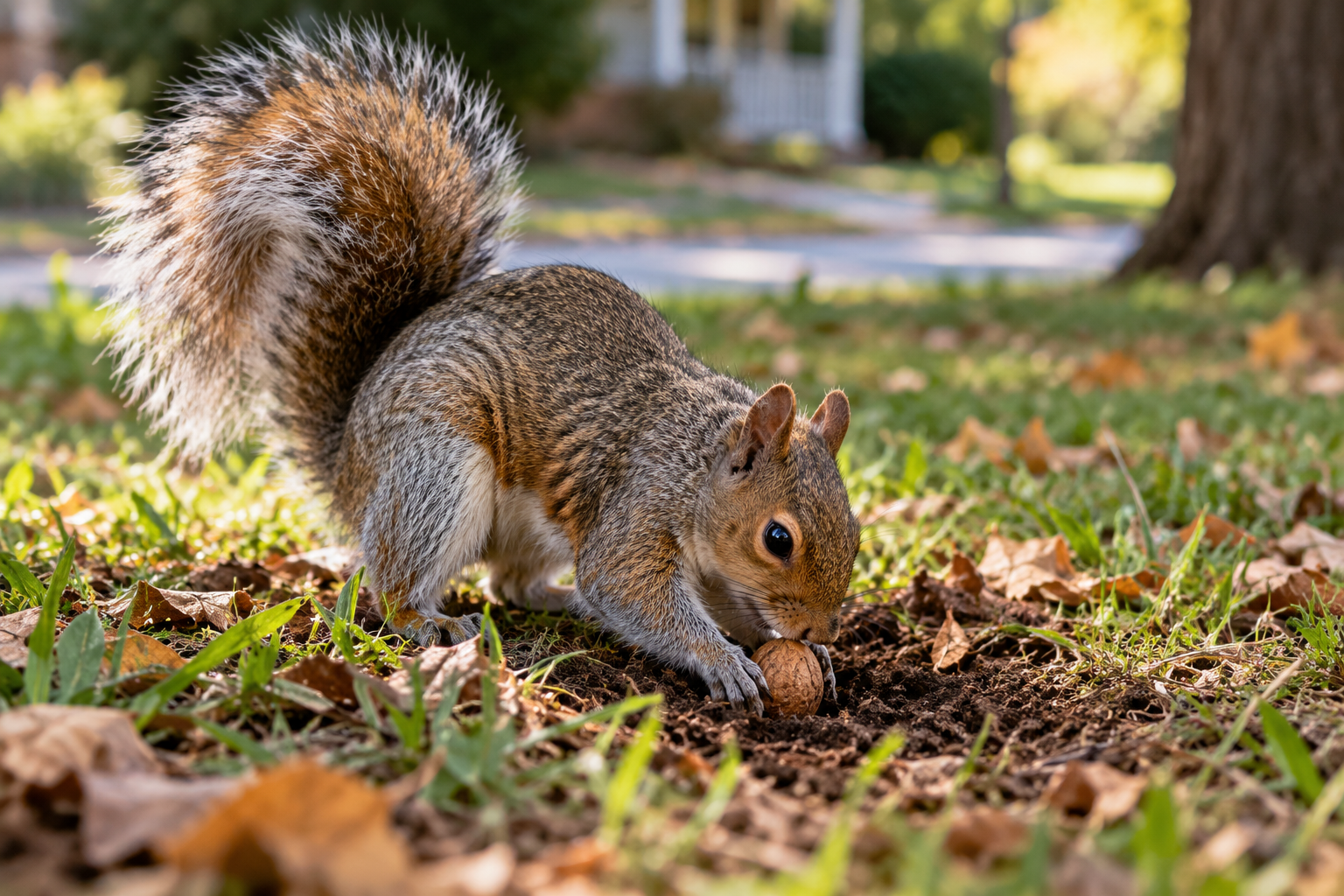
I was sitting on my porch watching a squirrel burying hickory nuts in my yard. I have watched squirrels do this countless times and never really thought much about it. This time, for whatever reason, I started paying attention to where the squirrel was taking them.
One went into the ground not far from the porch. The next one was carried maybe twenty feet away and buried in another part of the yard. Then the squirrel grabbed another nut, crossed the street and buried it in my neighbor’s yard. There didn’t seem to be any pattern to it, at least not one I could see. It was just one nut here, another over there, then off somewhere else with the next one.
Not a member? Read here
I looked at the places where the squirrel had buried them and thought, how in the world does it remember where all of those nuts are?
That was really all it took.
I knew squirrels buried nuts, but I had never stopped to think about how many they might actually hide. Depending on the species and food available, a squirrel can stash an incredible number of nuts during a year, with some estimates running into the thousands. I found references suggesting that number can reach around 3,000.
Now I was really curious. This little rodent was running around burying food all over the place and somehow had to find at least some of it again months later. I have trouble remembering why I walked into a room sometimes.
So, I did what I usually do when something catches my attention. I started digging, just not like the squirrel.
There is research into this, and squirrels apparently have very good spatial memories. They use landmarks and their sense of smell, and they don’t necessarily bury things randomly either. They appear to have ways of organizing caches that make it easier to find them later.
Okay, that makes sense.
But I was still sitting there looking at the squirrel. Its brain is tiny, yet somehow it can keep track of food scattered all over an area that isn’t going to stay the same. The grass will change. Leaves will fall. People will walk through the yard. A neighbor might mow over one of those spots ten times before the squirrel comes looking for what it buried there. What bothered me was that knowing how they do it didn’t make the ability seem any less remarkable.
Then I started thinking about salmon.
A salmon can leave the place where it was born, spend years traveling through an environment unimaginably larger than my yard and eventually find its way back. We know they use Earth’s magnetic field to help navigate across large distances and smell as they get closer to their home waters.
Sea turtles do something just as strange. They can travel enormous distances through the ocean and, years later, return to the same general area where they hatched. They also appear to use Earth’s magnetic field as part of the process.
I understand the explanation. What I kept thinking about was everything that happened between leaving and coming back.
Earth’s magnetic field isn’t fixed. It changes. Rivers change, coastlines change and years pass while these animals are somewhere else. Yet a salmon still finds the river and a sea turtle still finds its way back to the area where it started.
I kept thinking there had to be more to this. I just didn’t know what the “more” was.
That’s when this started connecting with something else I’ve been thinking about for quite a while.
I’ve written before about the possibility that consciousness may not exist entirely inside our brains. What if the brain isn’t simply creating consciousness but is connected to something larger? I’ve used the word receiver because I don’t have a better one. I don’t know what that larger thing is, how the connection would work or even if I’m right about any of it.
But as I sat there watching that squirrel, another possibility occurred to me.
Maybe we’re not the only ones connected.
I had been thinking about the brain as a receiver from a human perspective because I’m human. That’s the consciousness I know. But if there really is something larger that our brains connect to, why would that connection stop with us?
That squirrel has a brain. So does the salmon trying to find its way back to a river it left years earlier. So does the sea turtle crossing hundreds or thousands of miles of open ocean. They aren’t human brains, and there is no reason to believe they experience the world the way we do, but maybe that isn’t what matters.
Maybe the brain itself is the connection.
That doesn’t mean the squirrel isn’t using memory or smell. It doesn’t mean the salmon isn’t following magnetic information or recognizing its home waters. Those things can still be happening exactly as researchers describe them.
I’m wondering if there is something else happening along with them.
Dogs made me think about it in another way. People have been saying for generations that dogs somehow know things about us. Sometimes they seem to like or distrust someone immediately. They know when we’re upset, and anyone who has spent much time around dogs has probably had moments when the animal seemed to know something before we did.
There are good explanations for much of that. Dogs can smell things we can’t, notice tiny changes in our behavior and pick up signals we’re not even aware we’re giving them.
But once I started wondering about the squirrel, I couldn’t stop there.
What if a dog’s brain is connected to the same thing ours is?
I don’t mean that there is some giant invisible filing cabinet where a squirrel looks up the location of a hickory nut or a salmon asks for directions home. I don’t know what the connection would be, and pretending I do would ruin the whole point of asking the question.
Maybe there isn’t one.
Maybe everything I’m watching can eventually be explained by memory, smell, magnetic fields, instinct and biological processes we already understand or someday will. I have no problem with that answer if that’s where the evidence eventually takes us.
But I also don’t think we know enough about consciousness to assume that answer before we’ve even asked the question.
All of this started because I happened to watch a squirrel bury a few hickory nuts. The squirrel didn’t do anything unusual. It was doing what squirrels have probably been doing for longer than people have been sitting on porches watching them.
The squirrel grabbed another nut and took off across the yard.
I watched it go, and all I could think was, what if that little brain is connected to the same thing mine is?
Leave a Reply