Eyewitnesses, Aliens, and the Story I Didn’t Tell
When I wrote about the Black Pyramid beneath Alaska, I knew there was considerably more to the story than I was telling. There were accounts of people who claimed to have been inside it, allegations of secret government facilities, and even suggestions that the structure was connected to extraterrestrial technology.
I left those accounts out of the original article. Not because I had disproved them, but because I couldn’t substantiate them, and they didn’t belong in the investigation I was presenting.
Then the comments started coming in. Several readers wanted to know how I knew the pyramid was black. Another wondered why Alaska’s earthquakes hadn’t exposed it through seismic research. Others had questions about the people and stories surrounding the alleged structure.
Those questions brought me back to the material I had set aside. And there’s quite a bit of it.
The earthquake question is a fair one, especially considering how much the ground shakes in Alaska. The state experiences tens of thousands of recorded earthquakes each year, with 2018 having around 55,000. But an earthquake doesn’t automatically reveal everything beneath the ground. Scientists use seismic data to investigate particular geological structures, and what they can identify depends on the measurements available and what they’re looking for. As I discussed in the first article, researchers really did use seismic waves from a 1992 Chinese nuclear test to study structures deep beneath Alaska. That research didn’t reveal a pyramid, but it was an interesting connection to Douglas Mutschler’s account of a television report he said he watched in Anchorage.
What I hadn’t told readers was that some of the other accounts placed the alleged discovery decades earlier. In fact, one story suggested people were already working around the structure when I was still a kid.
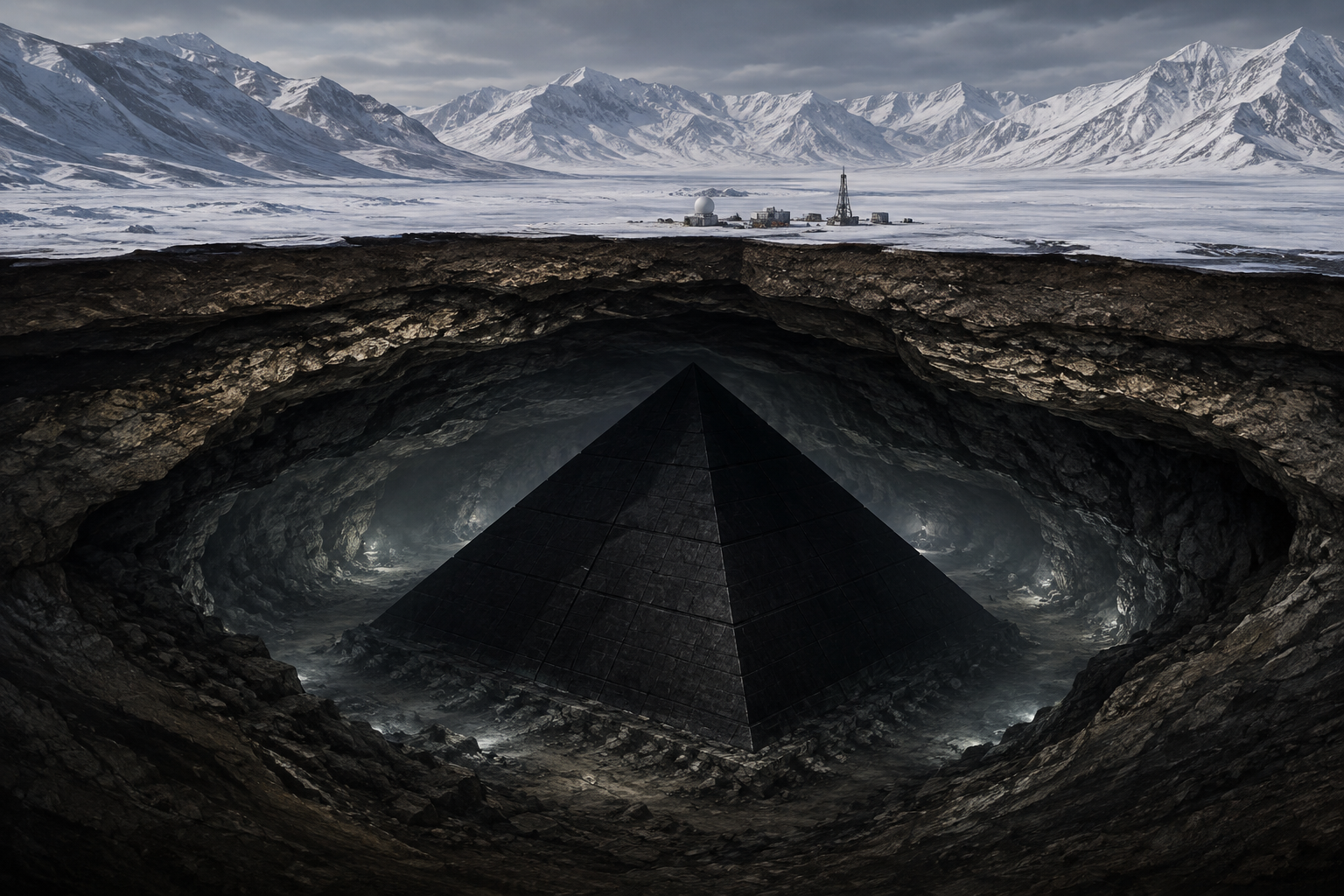
Linda Moulton Howe interviewed a man she called John Smith, who said his father had been an engineer with Western Electric. Sometime between 1959 and 1961, his father was reportedly sent to Alaska for an assignment involving electrical equipment. Smith claimed his father descended approximately 700 feet underground and encountered an enormous pyramid, roughly 550 feet tall, with its top about 150 feet beneath the surface.
Those are some impressive dimensions. The Great Pyramid of Giza originally stood about 481 feet tall, and here was an account of something even larger, completely buried. But it wasn’t the size that held my attention. Smith said his father had worked on electrical systems associated with the structure and believed it could produce enough energy to power Alaska and Canada.
Howe reported that she had obtained documentation supporting the father’s employment and military background. That doesn’t prove what he claimed to have encountered in Alaska, and the account came through his son rather than directly from the engineer. Nevertheless, I kept coming back to the dates. If the story was accurate, somebody had supposedly found this thing and was working on it more than thirty years before the television broadcast Mutschler described.
Then there was retired Navy Captain Mark Wood, who told Howe about a trip into remote Alaska aboard a Beaver aircraft. He described flying from Kaltag toward Telida and recalled an unusual runway capable of handling cargo aircraft. His account also involved a facility associated with the alleged pyramid and electromagnetic activity that he believed might have interfered with aircraft instruments.
Wood compared the possible energy system to Nikola Tesla’s ideas about transmitting electricity without conventional wires. Tesla had demonstrated wireless transmission of electricity, although his ambitions for a worldwide system ran into financial and commercial obstacles. Wood’s comparison caught my attention because I’d already encountered the engineer’s story about an enormous power source. Now there was one possibly beneath Alaska. Now another man was talking about electromagnetic activity associated with an installation in Alaska.
That doesn’t mean they visited the same place. The accounts don’t give us a consistently established location for the pyramid, and I couldn’t connect Wood’s trip to Smith’s father’s alleged assignment. Still, I found myself wondering what these men had encountered, assuming there was something behind their stories. The original television account was about a structure supposedly detected underground, while these two men were describing a place people could reach and work around.
I was familiar with another Alaskan underground-facility story, although it came from a very different direction. In 1973, Pat Price, a former police commissioner involved in remote-viewing research, reportedly described four extraterrestrial installations around the world. One was beneath Mount Hayes, Alaska. The others were said to be in Spain, Zimbabwe, and Australia.
Price’s accounts later became associated with Project 8200, which attempted to investigate the alleged facilities through remote viewing. The subject attracted U.S. government research during the Cold War, although the reliability of remote viewing remains disputed. What interested me here was the date. Price’s account of an alleged extraterrestrial installation beneath an Alaskan mountain appeared nearly twenty years before Mutschler’s reported broadcast.
Price was involved in the government-funded remote-viewing research that eventually became known as STARGATE, although his 1973 account of the alleged bases was produced independently. Years later, his descriptions became the basis for Project 8200, which sent other remote viewers back to those locations.
I couldn’t establish that Mount Hayes was the location of the Black Pyramid, and I wasn’t about to combine the two stories simply because they both involved Alaska. But by this point, the material I’d set aside included an engineer supposedly working around a buried pyramid, a Navy captain describing an unusual installation, and an earlier account of an underground extraterrestrial facility.
Now, I still hadn’t answered that reader’s question about the color.
While going through the material, I came across an account featured in The Alaska Triangle, in an episode called The Dark Pyramid. The woman said she was taken underground, through a series of tunnels and rooms that looked like some kind of laboratory. At one point, she looked through a window and saw an gigantic pyramid. She was looking right at its sloping wall.
She said it was made of black stone.
Well, there was my black pyramid. I hadn’t seen the thing myself, but there it was, at least in her account. After everything else I’d read, I finally had someone describing what this pyramid looked like.
And she didn’t stop with the stone.
The woman described a humanoid guide whom she understood was not human. She also spoke of humans apparently working alongside nonhuman beings within the complex, with energy emanating from the pyramid itself. Her account placed the structure inside what sounded like an operating facility, not an abandoned chamber or a forgotten archaeological site.
That was the moment when the stories almost seemed to come together for me. I thought about Smith’s father working on electrical conduits, Wood’s account of a remote installation and electromagnetic activity, and Price’s alleged extraterrestrial facility. Now here was a woman describing a black pyramid, people working around it, nonhuman beings, and an apparent energy source.
It almost felt like corroboration, even though I knew it wasn’t. These were separate accounts, and I couldn’t establish that they referred to the same place. But I could understand how the larger story had developed. Each account seemed to supply something the others were missing, and together they described something far more elaborate than a buried pyramid.
I could have ended my original article with those stories and left readers to consider the possibilities. I’d kept the first article focused on Mutschler’s story and what I’d found about the seismic research. There was plenty more to tell, but I wanted to give those other accounts their own space.
There was still one more account, though, and it took the subject somewhere I hadn’t expected.
In September 2021, Tom DeLonge appeared on the Peer Pleasure podcast and discussed an alleged underground pyramid in Alaska. DeLonge said he’d heard about the pyramid through a Pentagon contact, who told him a defense contractor had been studying it. According to that account, the contractor believed the pyramid was still operating.
According to DeLonge, the contractor believed the pyramid was operational. DeLonge said a contact at the Pentagon had told him about a defense contractor studying the pyramid. According to what he’d been told, the contractor believed the thing was still working.
DeLonge suggested that it could somehow be suppressing human consciousness.
Now, anyone familiar with my writing knows I’ve spent a considerable amount of time thinking about consciousness. I’ve explored the possibility that our physical brains might be connected to something beyond what we currently understand, and that consciousness may not be confined to the processes occurring inside our heads. So, when I encountered a claim about an underground structure supposedly influencing human consciousness, it was naturally going to get my attention.
I wondered whether DeLonge’s account had any connection to the energy described in the earlier stories. Was he talking about the same alleged structure, or had another extraordinary claim become attached to the Black Pyramid over time? I couldn’t answer either question, and his account didn’t explain how such a system would operate or what suppressing consciousness would actually involve.
But one detail stayed with me. The contractor believed the structure was operational. He wasn’t claiming that an ancient machine had once performed some extraordinary function before falling silent thousands of years ago.
He was suggesting that whatever the alleged pyramid was built to do, it was still doing it.
Leave a Reply