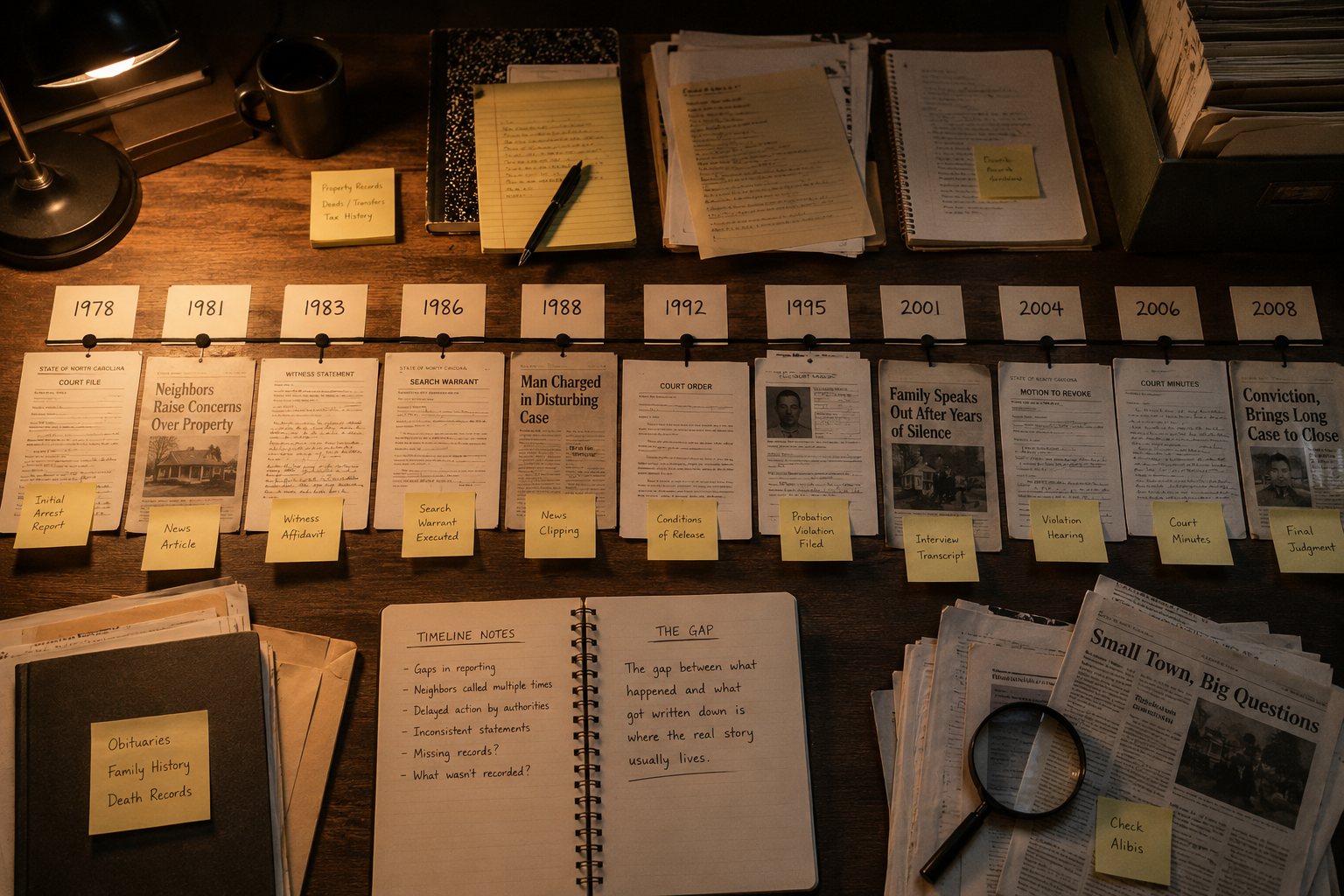
The gap between what happened and what got written down
Having just finished writing my second book about true crime there are a few things I wanted to share about the experience. I’ve known for a long time that court cases are never as cut and dried as the news makes them out to be.
Sure, there is an official record once everything is done, but what amazes me is how much is not included. How sometimes it takes years for justice to happen, and it usually comes down to someone talking.
Both books taught me things I couldn’t have read anywhere else. The first traced real murder cases across a century where a Ouija board ended up as evidence in actual courtrooms. People killed because of what it spelled out. A jury even used one once. The second went deep into a single house in Clemmons, North Carolina, where a convicted felon lived openly for years while a neighborhood watched, called it in, and nothing changed. Different cases, different decades, different questions. But the same lesson kept surfacing.
The gap between what happened and what got written down is where the real story usually lives.
These are some things I learned along the way.
The research is where most of the time goes. Not the writing. Not the editing. The sitting with documents that don’t immediately mean anything, waiting for them to connect to something else you found three weeks ago.
Some counties in North Carolina were still pretty backwoods about public records until fairly recently. For the Clemmons case I made the drive to the courthouse. One trip. A woman working there walked me over to a terminal and showed me that the state had built a public access system most people didn’t know existed. It wasn’t showing up in any typical search. You had to know to ask, and I didn’t until I walked through the door.
That’s usually how research works. You go somewhere to learn you didn’t need to go there. But you needed to go to learn that.
Court records are only one layer. There are property records, which tell you who owned what and when it changed hands. There are charge dates versus witness statements, and the gap between them can tell you how fast or how slowly a system was moving on something. There are probation records, other charges, prior convictions, all of them showing exactly what conditions were attached to someone’s continued freedom and whether those conditions were being met. Search warrants open up what investigators were actually looking for, which is often different from what they said publicly. Witness affidavits put you inside the moment someone decided to talk. You have to wade through marriage and divorce records. Obituaries tell you things families never say out loud in courtrooms. None of this announces its importance when you first pull it. You have to build your case notes over time and let the pieces find each other.
Newspaper accounts are their own separate layer, and they need to be treated that way. They were written fast, for readers who wanted a legible story, often before the full picture existed. In the Ouija cases I kept finding moments where the headline said one thing and the court transcript said something measurably different. Not small differences. Differences that changed what actually happened. You hold both and you don’t decide which one is right. The gap between them is usually where something worth knowing lives.
The Clemmons case gave me another sharp example of how this works. Witness statements and news articles repeatedly described Pazuzu Algarad with teeth filed down to points and a tongue split like a serpent. It circulated widely enough that it stopped being questioned. The autopsy report noted a few chipped teeth. Nothing more. That detail traveled through accounts for years, picking up certainty it never earned, because nobody checked it against the one document that couldn’t be exaggerated.
Documentaries are underused by most true crime readers and some writers. For the Clemmons book I found a five-part Vice TV series called The Devil You Know, written, produced, and directed by Patricia E. Gillespie, focused entirely on the case of Pazuzu Algarad. What that gave me was family statements, witness accounts, and voices from people who were inside that house during the years nothing officially happened. None of that was in any court record. Some of it contradicted what the official record said. All of it filled gaps I wouldn’t have known existed otherwise.
The notes accumulate. Folders inside folders. Dates that don’t match. Names spelled two different ways across two different documents. You build a timeline of your own before you trust anyone else’s, because the official timeline was assembled by people with limited jurisdiction and limited time, and it almost never tells the whole story.
It just tells the story that was possible to tell at the time.
Once the research is compiled, the next problem is what to do with it. Case notes for a book-length project accumulate fast, and at some point you are sitting in front of more information than any single narrative can hold. The temptation is to use all of it. That’s where most writers get into trouble.
I broke everything into a timeline first, then built chapter outlines and beat sheets from there. What that process forced was a discipline I wouldn’t have imposed on myself otherwise. Every piece of information had to earn its place in a specific chapter at a specific point in the sequence. More importantly, once something was placed, it stayed placed. One of the most useful things AI helped me with during the Clemmons project was keeping track of what had already been covered. I used it as a search tool within my own work. In a case that spans years, with overlapping characters and events, it is remarkably easy to find yourself explaining something the reader already knows three chapters back. That kind of repetition breaks the reader’s trust quietly. They don’t always know why the book lost them. But it did.
Getting the timeline right and keeping the information from doubling back on itself are two of the least glamorous parts of writing narrative nonfiction. They are also two of the most important.
Here is what that kind of research actually produces. In the Clemmons case, two separate murders and two missing people were all tied to the same house, the same people, and roughly the same window of time. That connection existed in the record. It was there. But it lived across different reports, different jurisdictions, different interactions with law enforcement that never got compared against each other.
At one point, a woman was at the police station talking about her missing ex-boyfriend, specifically mentioning that house, while someone else was in the same building reporting a separate missing person believed to have been murdered there. Nobody in that building put those two conversations together. It took over five years. It took a random conversion about something not even related to the case between a detective and someone who used to live in that house. Then it took three separate people to come in within days of each other and landing by chance with the same detective before anything finally connected.
As a writer you have an advantage law enforcement officials don’t. You get to play armchair quarterback after the game is over. A writer working on the full record sees what the official process missed. Not because the writer is smarter than the investigators, but because the writer has something investigators rarely have. Time. The ability to sit with documents from different sources, different years, different jurisdictions, and let them talk to each other. No shift change. No caseload. No reason to close the file.
That’s what a reader gets from a book built this way. Not just the story of what happened. The story of how long it took for anyone to see it whole.
There is one thing I was not expecting when I wrote these books.
I thought I was prepared for the weight of it. The research is methodical enough that it can feel like a distance. Documents, timelines, case numbers. You build a system and you work the system and for a while that feels like enough of a buffer between you and what you are actually looking at.
It isn’t.
At some point in both books, the victims stopped being names in a record. The families stopped being sources. You sit with someone’s story long enough, you follow it through every document that touched it, you find the places where the system should have caught something and didn’t, and something shifts. You feel the weight of what it meant to be those people. What it meant to the people who loved them and kept showing up and kept not being heard.
Nobody warned me about that part. I’m not sure anyone could have.
If you take anything from what I’ve shared here, take this. The research and timeline matter. Getting the facts right and keeping them honest matters more than almost anything else. But underneath all of it, you are telling someone’s story. Someone who didn’t get to tell it themselves. That’s worth doing carefully. That’s worth doing slowly and it’s worth doing right.
Leave a Reply