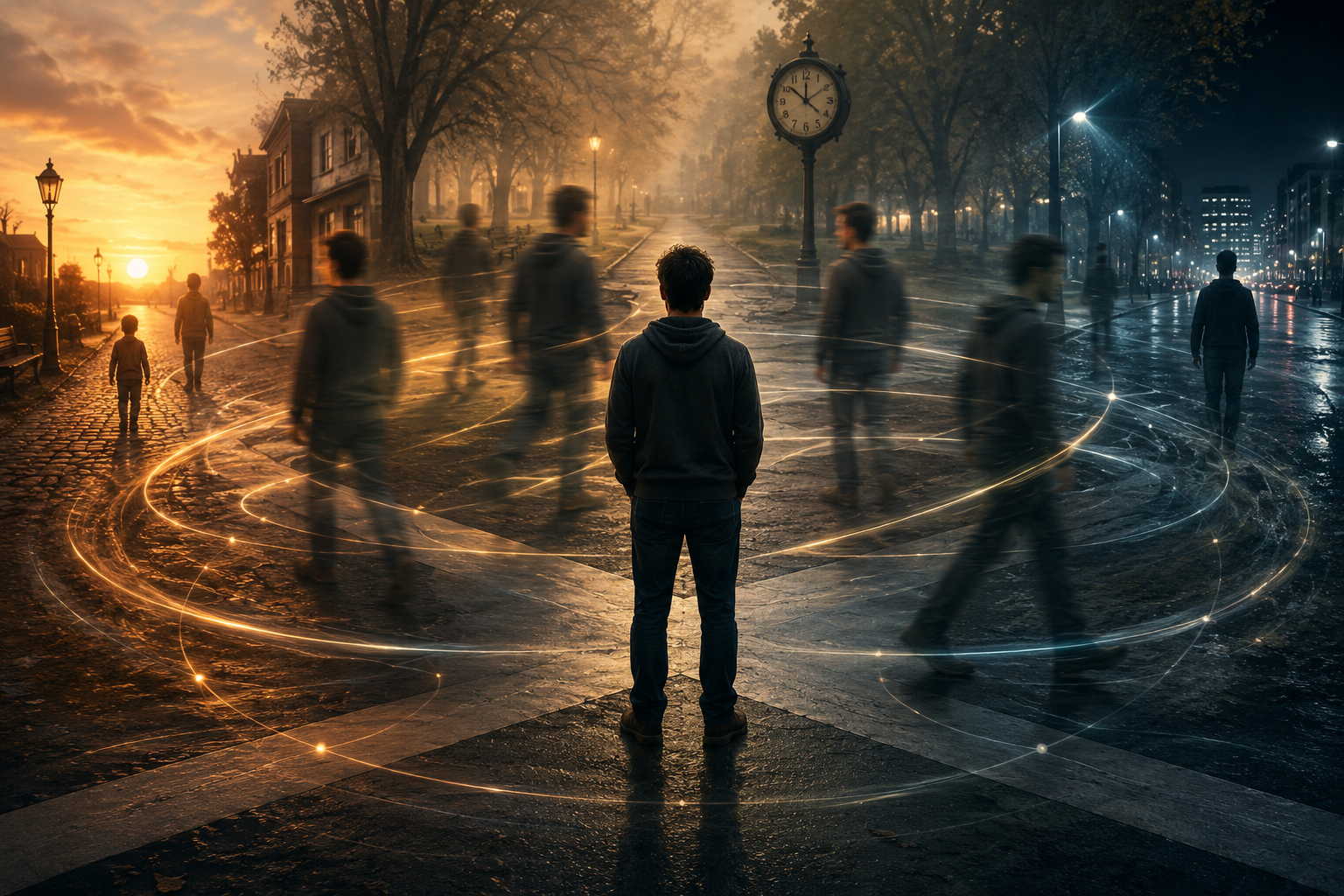
What If Ghosts, Déjà Vu, and Near-Death Experiences Are All the Same Thing
We’re constantly told that everyone has the same twenty-four hours in a day. But is that really true?
Time seems to shift depending on how we experience it. Sixty seconds does not sound very long until someone cannot breathe. Five minutes waiting for help can feel like an eternity. A single night of grief, fear, or physical pain can stretch so long it barely feels survivable. Then somehow entire years disappear almost unnoticed inside routine.
Childhood summers once felt endless. Adult life often feels like someone has pressed the gas pedal to the floor in the car of life.
If people already experience time so differently internally, why are we so certain we fully understand what time actually is?
For most of modern life, we are taught to think of time as something fixed and linear. The past is gone. The future has not happened yet. Everything moves forward in a straight line from birth to death. We organize our entire lives around that assumption without ever really questioning it because clocks work well enough for survival. Schedules work. Calendars work. Deadlines work. But measuring something is not the same thing as fully understanding it.
We experience our time as movement. Forward. Constant. Sequential. One moment disappears and another replaces it. That feels obvious because it is how consciousness seems to function. We remember the past, experience the present, and anticipate the future. But that does not automatically mean time itself is structured that way. It may only mean that this is how we perceive it while moving through whatever reality actually is.
For centuries, people assumed the sun moved around the Earth because perception appeared to confirm it every single day. The experience felt undeniable. Stable. Rational. Then a man named Nicolaus Copernicus helped expose the flaws hidden inside that certainty. The Earth was moving too. People simply could not perceive it from where they stood. It is possible our understanding of time may eventually look similar.
It is strange when you really think about it. We symbolize time with circles. Clocks rotate endlessly. Planets orbit. Seasons cycle. Life itself moves through repeating patterns. Yet at the same time, we think of existence as a straight line moving from beginning to end. Birth. Life. Death. Past behind us. Future ahead of us.
Maybe those two ideas were never fully compatible to begin with.
We measure time linearly because linear measurement helps organize survival. It helps civilizations function. But reality itself may not actually move that way. Nature rarely does. Planets orbit. Galaxies rotate. Seasons return in cycles that are never completely identical. Even our own lives move through emotional and psychological patterns that repeat without perfectly repeating.
What if time behaves less like a straight line and more like overlapping orbital paths?
Not perfect circles endlessly looping backward, but layered trajectories moving beside one another through the same larger structure. Paths that occasionally drift close enough together to interact in ways we do not fully understand.
If time behaves more like overlapping orbital paths than a straight line, then reality may not be as separated as we assume it is. We tend to think of the past as gone and the future as unreal because that is how consciousness appears to move through experience. But what if different periods of time exist beside each other instead of behind each other?
Not fully merging. Not collapsing together. Just drifting close enough at certain points to briefly touch, the way neighboring orbits sometimes pass through the same region of space.
Under that possibility, some of the stranger experiences people continue reporting throughout history begin looking different. Déjà vu stops feeling like a meaningless mental glitch and starts looking more like momentary overlap. Near-death experiences stop sounding less like endings and more like transitions people struggle to describe after returning. Religious ideas about other realms begin feeling less like primitive superstition and more like symbolic attempts to explain encounters with something beyond ordinary perception.
Even the more bizarre reports humanity continues to produce begin taking on a different shape. Hauntings. Time slips. Encounters with things people insist should not exist. Stories that continue generation after generation no matter how aggressively modern culture dismisses them.
Most people separate those experiences into categories. Paranormal. Psychological. Religious. Folklore. But what if at least some of them are not separate at all? What if they are brief moments where different layers of reality drift unusually close together before separating again?
Maybe that is also part of why so many people quietly feel disconnected from modern life even when everything outwardly appears normal. Most of us live inside systems built almost entirely around linear progression. School. Career. Retirement. Productivity. Aging. Deadlines. Constant forward motion. The structure leaves very little room for mystery because mystery interrupts efficiency.
But people do not experience existence mechanically no matter how hard modern culture tries to condition them into it.
People still dream about places they have never seen. They still wake up feeling the presence of loved ones after death. They still experience moments that feel strangely outside ordinary sequence. They still report experiences that logic alone never fully dissolves emotionally even when rational explanations exist.
Maybe the fear people feel around uncertainty is not actually fear of the unknown. Maybe it is fear that reality is far less stable, linear, and controllable than we want it to be.
Because if time is not strictly sequential, then existence itself changes shape. Death changes shape. Memory changes shape. Consciousness changes shape. Even the idea of being “gone” starts becoming harder to define cleanly.
Maybe none of this is true. Maybe every strange experience people report can eventually be explained through psychology, biology, stress, pattern recognition, and the human tendency to search for meaning. That remains possible.
But it is also possible that people have become so conditioned to think of time as a straight line that we mistake our perception of reality for reality itself.
That’s a good softening turn because it keeps the article intellectually honest while maintaining tension.
Then maybe move into something deeply human:
Most people spend their lives racing forward through time without ever questioning what time actually is. We measure it constantly. Fear it constantly. Feel chased by it constantly. We organize our entire existence around beginnings and endings.
But if existence behaves more like overlapping cycles and layered orbits than a simple line moving from past to future, then maybe death is not as absolute as we imagine. Maybe memory is more than stored information. Maybe some of the moments people dismiss as strange are not glitches in consciousness at all, but brief reminders that reality may be far larger than the narrow version we experience day to day.
Maybe the clock was never showing us the full picture. Only the part of reality we needed in order to move through it.

Leave a Reply