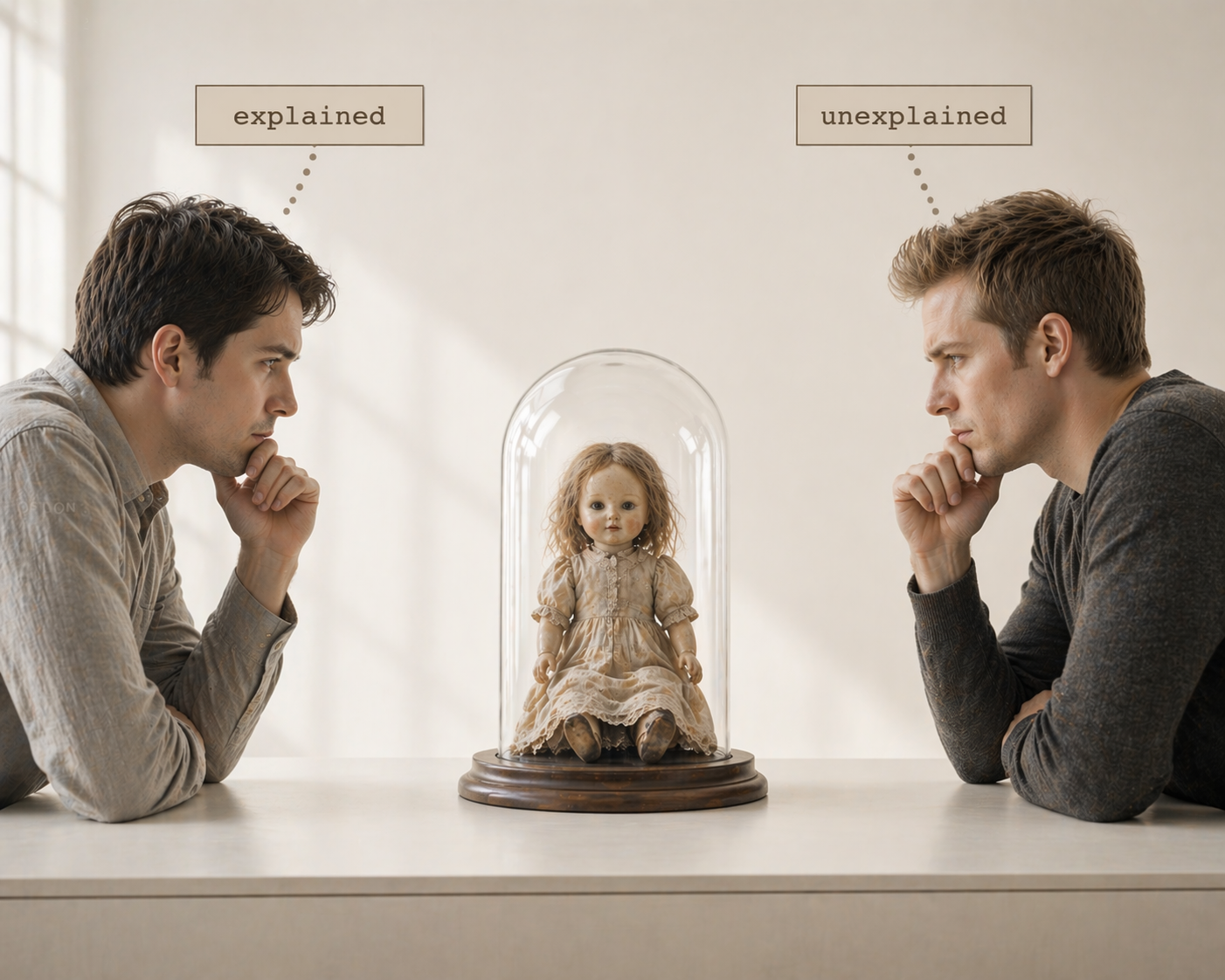
The case changes the moment people decide what they believe
In 1975, the Lutz family moved into a house in Amityville, New York. Within weeks, they left, claiming a series of disturbing experiences inside the home. Their account included strange odors, physical sensations, and a growing sense that something in the house was not right. From that point forward, the case split.
Some accepted the account as a legitimate haunting. Others dismissed it outright, pointing to inconsistencies, possible financial motives, and the involvement of outside figures who had their own reasons for keeping a story like this alive. Even among skeptics, the response wasn’t consistent. Some held the position long enough to test what was being claimed. Others moved past that step almost immediately. At a certain point, skepticism stops testing the claim and starts assuming the answer. That’s not skepticism anymore. It becomes cynicism.
That division didn’t stay in public discussion. It carried into everything that followed. Investigators didn’t walk into that house empty. They came in with assumptions already forming, sometimes already set. The questions reflected that. They leaned. They moved toward an expected outcome instead of holding open space long enough to see what was actually there. Evidence didn’t just sit on its own. It was filtered through what someone already thought the case was. Some details were held up. Others were pushed aside or explained away before they were fully worked through. Over time, the case shifted. It stopped being about what happened inside that house and started becoming something else. A position. A side. Something people chose and then defended.
Because once a case is framed as skeptic versus believer, the focus changes. It stops being about understanding the event and starts becoming about defending a position. And when that happens, both sides begin to do something very similar. They stop asking what can be confirmed and start asking what supports what they already think. That pattern doesn’t appear at the end of a case. It shows up early, often before there’s enough information to justify either position.
The debate itself tends to follow a familiar path. One side insists there’s a rational explanation for everything. The other is just as certain that something real is being dismissed too quickly. They push against each other; each convinced the other is missing something obvious. And maybe they are. But not in the way either side thinks. Because the skeptic versus believer argument assumes the most important question is whether something is real, when in many cases that isn’t what determines the outcome.
What matters more is what people do once they decide what’s real, or decide it isn’t. That decision happens early. Sometimes before the available information supports either conclusion. And once it’s made, it doesn’t stay contained. It begins to shape behavior. You see it in how witnesses describe what they experienced, in how investigators decide what to prioritize, and in how quickly explanations get accepted or rejected based on what someone already believes should be possible. At that point, the debate isn’t clarifying anything. It’s directing the case.
Skepticism, in its intended form, is a filter. It slows things down, tests claims, and keeps speculation from moving ahead of evidence. At its best, it does exactly that. But in cases like this, it can shift without much notice. From testing, to dismissing. Once that happens, the goal changes. It’s no longer about understanding what occurred, but about restoring a sense of normalcy as quickly as possible. Details that don’t fit are minimized. Witness accounts are treated as unreliable before they’ve been fully examined. The assumption becomes that if something doesn’t make immediate sense, it probably isn’t accurate. That approach feels grounded, even responsible, but it can close off lines of inquiry before they’ve been followed.
Belief doesn’t move the same way. It doesn’t wait. It starts building meaning almost immediately, especially when something feels intense or out of place. Details don’t stay separate for long. They get connected, sometimes too quickly. Gaps don’t stay open either. They get filled, often with whatever explanation carries the same weight as the moment itself. At its best, that keeps possibilities open. There is some flexibility with this as compared to something that’s strictly defined; however, this also comes at a price. A lot of patterns will develop before they truly exist (in the context of those individual elements being present). Many separate elements will begin to join and form some sort of whole that feels complete, even if it doesn’t really exist as a complete whole. After that, it becomes very difficult to return to the original state of experience, because that original experience now has been overlaid with subsequent stories built upon the original story.
On the surface, these two positions appear to be in direct opposition. One rejects too quickly. The other accepts too quickly. But the outcome often lands in the same place. Both stop asking what can be confirmed. Both begin filtering information through a position instead of allowing the information to shape it. And once that shift happens, the case starts moving in a direction that has less to do with what occurred and more to do with how it’s being interpreted.
Most people don’t notice this until they’re already inside it. It feels natural to take a position, to decide what makes sense, to lean toward an explanation that fits how they already see the world. But once that position sets in, it begins to shape more than opinion. It shapes what gets noticed, what gets questioned, and what gets accepted as possible. From that point on, the case is no longer being examined from the outside. It’s being filtered from within.
That’s where things begin to shift. Not because the unknown is overwhelming, and not because the evidence disappears, but because interpretation gets there first. If you can step back from that, even slightly, the case changes. Not because the unknown is resolved, but because it’s no longer driving everything else. You don’t have to choose a side immediately. You don’t have to resolve what isn’t ready to be resolved. You only have to hold the question long enough to see what actually holds up.
Because in the end, the skeptic versus believer debate rarely reveals the truth. It reveals how quickly we decide what the truth should be.
Leave a Reply