How April 30th went from a pagan sabbath to a Christian feast day, and what that tells us about how the Church actually built its power.
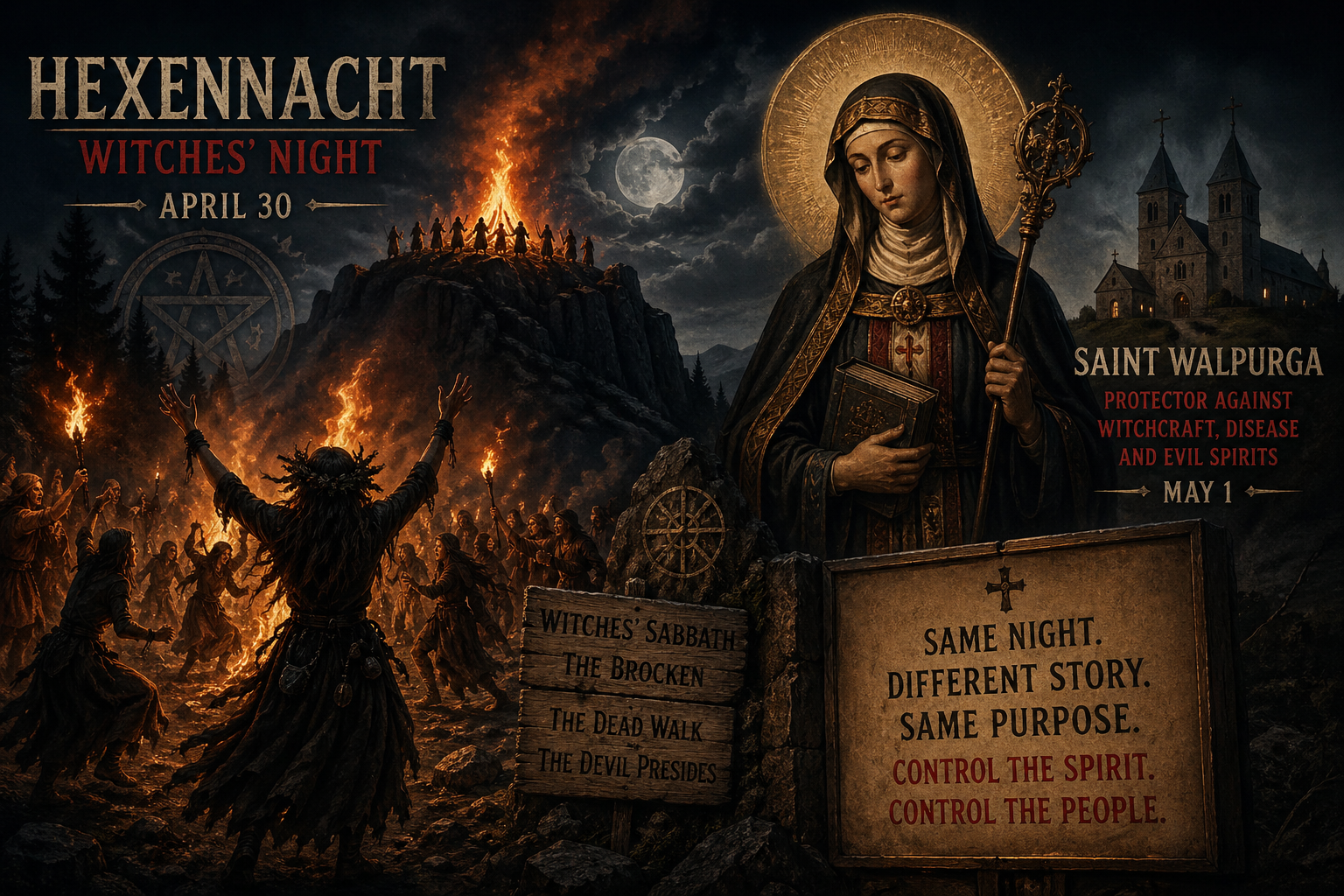
Picture the Brocken on the night of April 30th. It is the highest peak in Germany’s Harz Mountains, wreathed in fog, lit by bonfires. In the folk imagination of medieval Germanic Europe, this was the night the witches came, gathering at the summit for a great sabbath, feasting, dancing, calling in the spring with noise and fire. The dead walked. The devil presided. And over all of it hung the name: Hexennacht. Witches’ Night.
Now consider this: the very next day, May 1st, is the feast day of Saint Walpurga, an 8th-century Christian abbess who was venerated specifically for her protection against witchcraft. Her feast day was inserted into the Christian calendar at precisely the moment when the ancient pagan celebration was at its loudest.
To understand Hexennacht, or Walpurgisnacht, to use its full German name, you have to understand what the night originally was. Long before Christianity reached the Germanic peoples of northern Europe, April 30th marked the midpoint between the spring equinox and the summer solstice. It was one of the great threshold moments of the agricultural calendar. Winter was over, the growing season was beginning, and the boundary between the living world and the spirit world was believed to be dangerously thin.
Across Celtic and Germanic traditions, these liminal nights were treated with a mixture of reverence and dread. Protective bonfires were lit to drive away malevolent spirits. Noise was made, drums, horns, shouting, to chase the darkness back. Livestock was driven between flames to purify them for the new season. The wild energy of the night was real and communal. It predated any church by centuries.
“The witches’ sabbath and the anti-witch saint share the same night on the calendar. That is not a coincidence. It is a policy.”
Now enter Saint Walpurga. Born in what is now England around 710 AD, she was a Benedictine nun who traveled to Germany as a Christian missionary. By all accounts she was a formidable figure. She was educated, fearless, and deeply effective in spreading the faith among pagan populations. She founded monasteries, led communities of both men and women, and died in 779 AD. She was canonized in 870 AD and here is where the story gets interesting. Her feast day was set for May 1st, which placed her holy eve, the night of prayer and vigil before her feast, squarely on April 30th. The same night as the pagan gathering on the Brocken. The same night as Hexennacht.
The symmetry is too precise to be accidental. And it wasn’t.
In 601 AD, Pope Gregory I, Gregory the Great, wrote a letter to Abbot Mellitus, one of the Christian missionaries working to convert the Anglo-Saxons of Britain. The letter, known as the Epistola ad Mellitum, contains one of the most candid admissions in the history of organized religion. Gregory instructs his missionaries not to destroy pagan temples and not to suppress pagan festivals, but to co-opt them. Consecrate the temples as Christian churches. Replace the pagan celebrations with Christian feast days held at exactly the same time. Let the people gather where they have always gathered, celebrate when they have always celebrated. Just change what they’re celebrating.
“If those temples are well-built,” Gregory wrote, “they should be converted from the worship of demons to the service of the true God.” The feast days were to be rededicated, the bonfires reframed, the communal energy redirected. It was an instruction manual for spiritual rebranding, issued by the highest authority in Western Christianity, and it worked with extraordinary effectiveness across two continents and a thousand years.
Walpurga’s placement on May 1st is Gregory’s playbook in action. Here was a night when Germanic people were going to gather anyway, lighting fires, making noise, appeasing spirits. Rather than fighting that, the Church gave them a saint whose power was specifically defined as protection against the forces they feared on that night. The wild energies of Hexennacht didn’t disappear. They were simply assigned a new supervisor.
The irony runs deep. Walpurga’s legend is built almost entirely on opposition to witchcraft. She is invoked against sorcery, against evil spirits, against disease and crop failure. The exact threats that the old pagan rituals were meant to address. The Church replaced a tradition of managing dangerous supernatural forces with a saint whose purpose was to protect against them. Same fears. Same night. Different framework.
And yet the old tradition survived completely intact inside the new one. Across Germany and Scandinavia, the bonfires of Walpurgisnacht never actually stopped. People kept lighting them. They kept making noise. In many communities, the folk practice of dressing as witches continued alongside the church calendar rather than being replaced by it. The pagan substrate was simply too deep, too woven into the seasonal rhythm of people’s lives, to be fully overwritten. What the Church achieved was a kind of layering. The Christian story was placed on top, but the original text remained legible underneath.
Hexennacht is far from unique in this regard. Christmas absorbed the Roman Saturnalia and the Germanic Yule, complete with the evergreen trees, the feasting, the winter fire. Easter carries the name, and the eggs and rabbits, of the spring goddess Ēostre. The Christian calendar is, in significant part, an archaeological record of the pagan calendars it displaced, preserved in the very feast days that were meant to replace them.
What Gregory’s strategy actually accomplished was a transfer of authority, and that transfer was the point. The old festivals had been communal and ungoverned. Anyone could light a bonfire, anyone could lead the ritual, anyone could negotiate directly with the forces of the night. The Church replaced that with a saint, a feast day, a priest. It didn’t just absorb the tradition; it inserted itself as the only legitimate passage through it. Access to the divine, to protection, to salvation, to meaning itself, now required an intermediary. And that intermediary was Rome. The fears remained the same. The night remained the same. But the Church now held the only key.
On the night of April 30th, the bonfires still burn across Germany. The witches still dance, at least in costume. The old Brocken still draws crowds. And the feast of Saint Walpurga, protector against witchcraft, still follows at dawn. It is a perfect palimpsest: two traditions written on the same night, one on top of the other, both still visible to anyone who looks closely enough.
The witches, it turns out, were never actually driven away. They just learned to share the calendar.
Leave a Reply