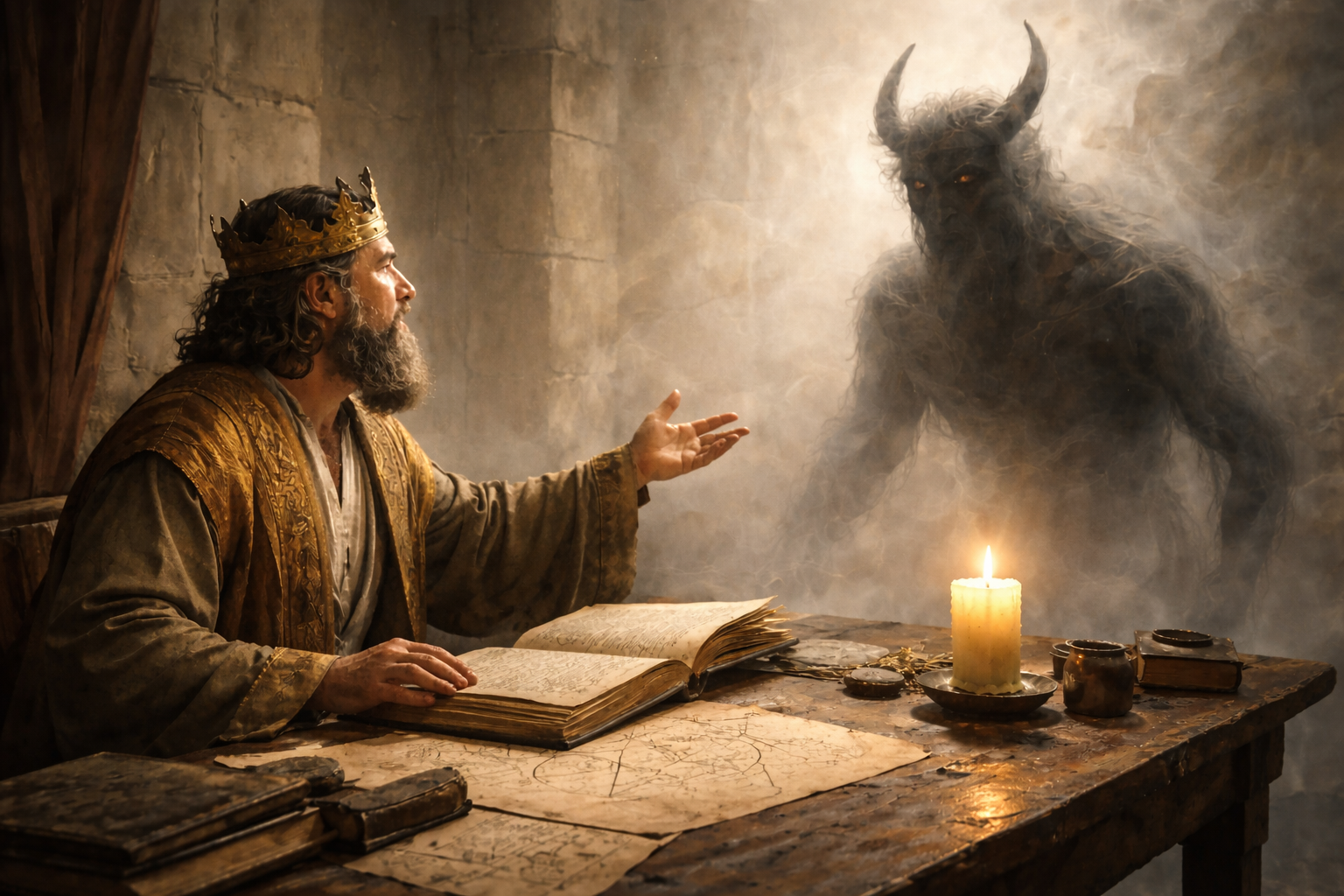
If demons aren’t real, why do so many ancient texts describe rituals meant to keep them away… and others designed to call them in?
Sit with that for a second or two.
Not as an idea. As a pattern.
Because this isn’t one culture, one belief system, or one period of time trying to explain something it didn’t understand. This is the same structure showing up over and over again, in places that had no contact with each other, no shared language, no way to compare notes, and still arriving at the same conclusion.
There are things that can enter.
There are ways to force them out.
And there are ways to bring them in on purpose.
That last part is where it stops being easy to dismiss. Removal is one thing. Invitation is another. It is one thing to fear demons. It is another to believe they can be summoned, questioned, bound, bargained with, or used. Traditions surrounding figures like King Solomon are built on exactly that assumption. Not just that demons exist, but that they respond.
Fear explains why people try to remove demons. Illness, misfortune, sudden shifts in behavior, mental and physical collapse without a clear cause. All of that needed an explanation long before medicine and psychology had their own language for it, if they even fully do now. Demons became one answer. That part makes sense.
But explanation does not require invitation.
You do not build rituals to summon something you believe is only in your head. You do not attach warnings, conditions, and consequences to something imaginary. You do not refine methods across generations unless, at some level, you expect a response.
And yet, that is exactly what exists.
Not just exorcisms. Conjurations.
Not just protection. Access.
Across time, across cultures, across completely different systems of belief, the same assumption holds: demons are not just something to fear. They are something that can be engaged, something that seems to predate the rituals built around them, older than the words used to name them, older perhaps than the people trying to keep them out or bring them in.
That idea never stayed in the past.
It is still here, only dressed in softer language. People do not always say demon now. They say entity, attachment, presence, influence. It sounds cleaner. Less ancient. Less loaded. But the structure has not changed. There are still people trying to remove something from themselves or others. Still people who are trying to contact, channel, or invite something in.
Different terms.
Same behavior.
So, the question does not go away just because we have become more sophisticated in describing the human mind.
If demons do not exist, then this is one of the most persistent and structured human errors ever repeated. Not just belief, but interaction. Not just fear, but systems built on the expectation that something responds.
Or this is not an error at all.
It is a response.
To something people did not invent, did not fully understand, but encountered often enough to build methods around it. Methods to keep it out. Methods to bring it in. Not something newly imagined by frightened people, but something they believed was already here, waiting before they named it, waiting before they feared it, waiting before they tried to command it.
That is the part that does not resolve cleanly.
And it is still happening.
Leave a Reply