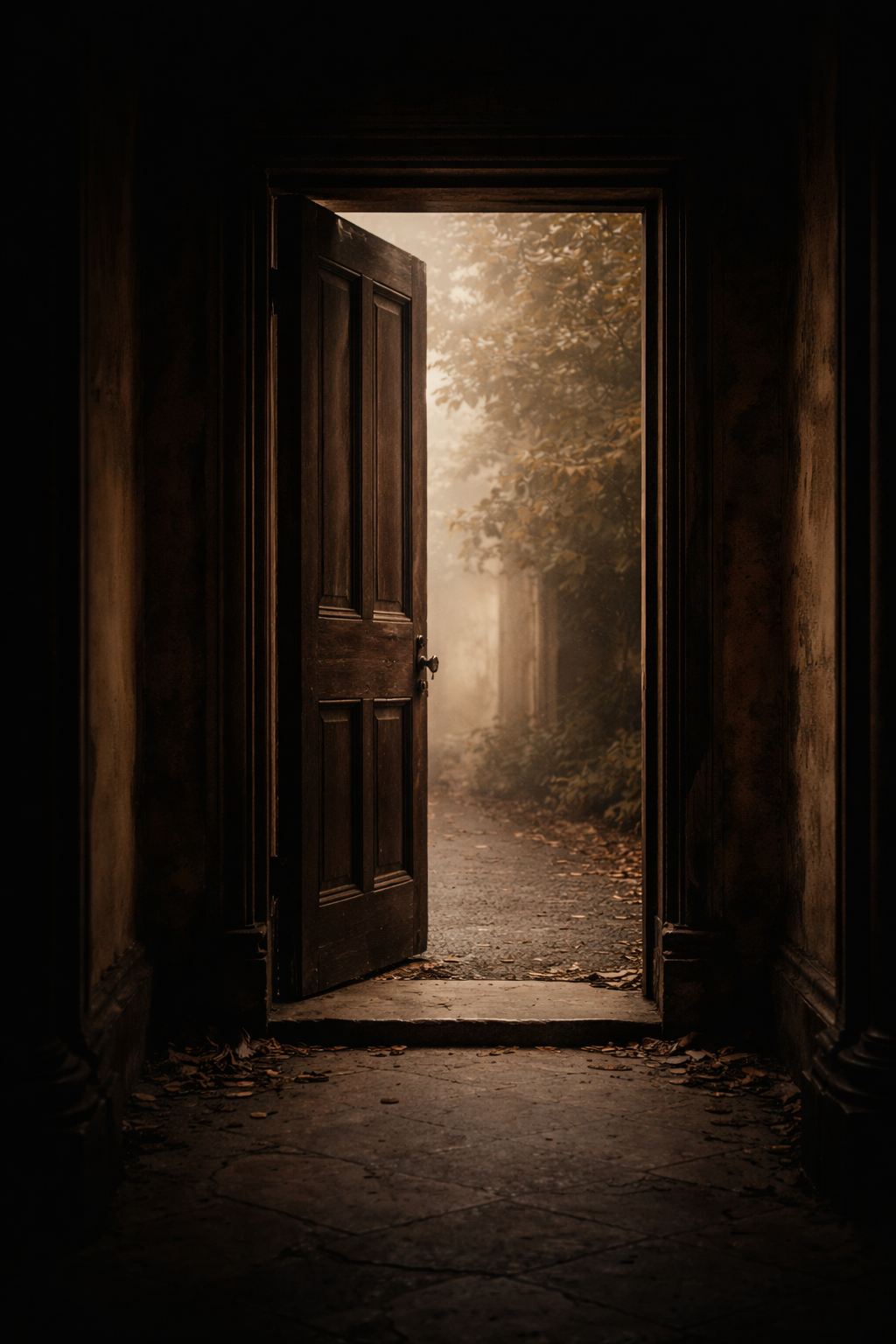
Thresholds
First published on Medium
Every home has one, and almost no one notices it.
The threshold is crossed dozens of times a day. Shoes scrape over it. Groceries pass over it. Children step across it without thinking. It marks the shift from outside to inside so cleanly that it feels purely practical, almost invisible.
Historically, it was anything but.
For most of human history, the threshold was considered the most unstable point in a home. Not a wall. Not a window. The doorway itself. It was a place where definitions blurred, where rules weakened, and where unwanted things could slip through if they weren’t actively discouraged.
This wasn’t symbolic thinking. It was defensive.
Ancient households treated thresholds as sites of constant negotiation. What crossed into a home did not arrive neutral. Illness, misfortune, spirits, and the dead were all believed to move more easily through liminal spaces, places that were neither fully one thing nor another. The threshold was the most obvious of these spaces, and therefore the most dangerous.
That danger explains practices that still linger today, stripped of their original meaning.
In Roman homes, thresholds were protected by offerings and honored through household rites. The god Janus, with one face turned inward and one outward, presided over doors and gates because thresholds required vigilance in both directions. What entered mattered. What left mattered too. A poorly guarded threshold invited imbalance.
Elsewhere, the concern took more physical forms. Archaeology has repeatedly uncovered animal bones, iron objects, and written charms buried beneath doorways. These weren’t decorative. They were anchors. The belief was that the threshold needed weight, something binding, to hold the home together and prevent intrusion from forces that didn’t respect walls.
Blood was sometimes used for the same purpose.
In older European folk traditions, a newly built home was often “fed” at the threshold. A sacrifice, animal or symbolic, was offered to claim the space and establish boundaries. The idea wasn’t cruelty. It was containment. A home without a properly established threshold was vulnerable.
This fear of the doorway explains a number of customs that survived long after their origins were forgotten.
Carrying a bride over the threshold was not romantic. It was protective. The belief was that the bride, entering a new household, was particularly susceptible to spiritual interference. Allowing her to step directly on the threshold risked exposure at the moment she was crossing into a new identity. Lifting her was a way of bypassing the danger.
Not stepping on thresholds at all was once common practice. People avoided lingering in doorways. Conversations were discouraged there. To pause at a threshold was to invite disruption. Even now, standing half in and half out of a room carries a faint social discomfort. We still sense that it’s not a place to stay.
Keys and locks came later. Long before physical security, thresholds were guarded ritually. Salt scattered across the doorway. Iron hung above it. Words spoken before crossing. Gestures made without conscious thought. These actions were meant to signal that the space beyond was claimed, ordered, and defended.
The dead were a particular concern.
Many traditions held that spirits lingered near thresholds because they represented unfinished movement. The dead had left one state but not fully entered another. This is why funeral practices often involved specific instructions for doors, when to open them, when to close them, when to block them entirely. A poorly managed threshold could allow the dead to return, not as memory, but as presence.
What’s unsettling is how much of this still influences behavior, even in people who would dismiss it outright.
We knock before entering, even when we know no one is inside. We announce ourselves when crossing certain thresholds. We feel uneasy when doors open on their own. We lock doors at night not just for safety, but for closure. The threshold is sealed. The boundary is restored.
Windows let light in. Walls hold space. But thresholds decide what crosses between worlds.
They always have.
We’ve trained ourselves to see them as architectural details, nothing more than trim and flooring. But the instincts around them persist because they were shaped by centuries of belief, fear, and ritual practice. The threshold was never just a line. It was a test. A filter. A warning.
And even now, no matter how rational we believe ourselves to be, we don’t quite trust the space where outside becomes inside.
We step over it quickly.
Just in case.
Leave a Reply