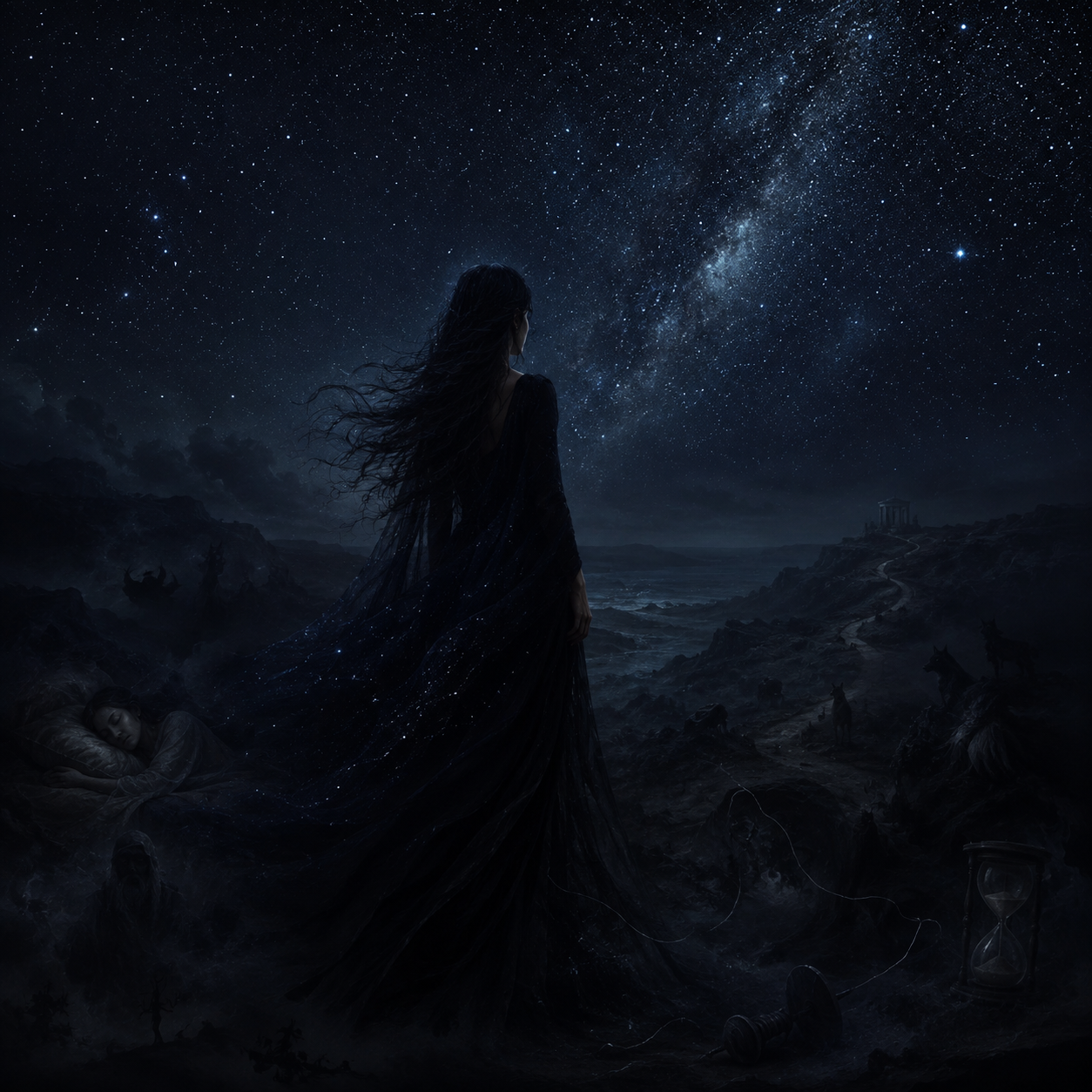
I Wasn’t Looking for Nyx When She Found Me
Death and Sleep were brothers, and their mother was Night. There was something about that ancient Greek genealogy that made immediate sense to me, even though I’d barely heard of Nyx before that day. Keep following her family tree and it becomes even more remarkable. Fate is there, along with Doom, Strife, Retribution, Old Age, Dreams, and other things we as humans have spent thousands of years worrying about after the sun goes down.
Of course they should be children of Night.
That was my first reaction, and it was strong enough that I stopped what I was doing and started reading. I knew the name Nyx. I knew she belonged somewhere in Greek mythology, but that was about the extent of it. Zeus, Athena, Apollo, Hades, those are gods most of us grow up knowing, whether we care about mythology or not. Nyx somehow escaped me.
Maybe that’s because calling her a Greek goddess doesn’t quite explain what she is. Nyx wasn’t given dominion over the night the way Poseidon was given the sea. She wasn’t responsible for bringing night or controlling what happened there.
Nyx was Night.
Not darkness. That’s an important distinction. The Greeks had another primordial being for darkness, Erebus. Nyx was the night itself, something far older than Zeus and the familiar Olympians. Hesiod placed her close to the beginning of everything, born from Chaos, before the mythology settles into the world most of us recognize.
I promised myself I wasn’t going to turn this into a lesson on Greek mythology, partly because I’m not qualified to give one and partly because that wasn’t what interested me anyway. It was her children I kept coming back to.
Hesiod gave Nyx quite a family. Without a consort, she bore Doom, Death, Sleep and Dreams. There was Misery, along with the Fates, Nemesis, Deceit, Old Age and Strife. Other ancient writers changed and expanded the genealogy, as mythology tends to do, but the pattern remained remarkably recognizable. Night was the mother of forces that we still associate with what happens when the light disappears.
Sleep and Death especially stayed with me.
We close our eyes every night and surrender ourselves to something we cannot consciously control. Most of us don’t find that particularly frightening because we expect to wake up. Death asks for a similar surrender without making that promise. The ancient Greeks made them brothers.
The more I thought about that, the less strange Nyx’s family seemed.
We are different creatures at night. A corner of the yard that wouldn’t get a second glance at noon can become something else when we can’t quite see what’s standing there. A noise downstairs means more at two in the morning. The clothes hanging over a chair can become a person for the half second before our rational mind catches up.
Night didn’t put the person there. We did.
That may be the part of Nyx that interests me most. She doesn’t need to be evil for us to fear her. She doesn’t need to threaten us at all. She only has to take away enough light that we can no longer be certain about what surrounds us. We supply the rest.
Fear is ours.
We can let it control us, or we can use it. Fear can warn us when something is wrong. It can make us pay attention. Sometimes it forces us to look directly at something we would much rather ignore. The problem isn’t that fear exists. The question is what we do once it arrives.
That was about the point when the timing of my encounter with Nyx started bothering me.
Shortly before she appeared in my feed, I had been considering writing something about the Dark Night of the Soul. There are two lines I carry with me:
You cannot begin anew without the Dark Night of the Soul. A total and complete annihilation of everything you ever believed in, and everything you thought you were!
You cannot go through hell without bringing back some of the darkness as a souvenir.
I started writing that article. Then I stopped.
There was no way for me to write it honestly without going places that were too dark and too personal for me to put out there. I could have sanitized it, but then there wasn’t much point in writing it at all. So I scrapped the piece.
Then Nyx appeared in my feed.
Make of that what you will. Algorithms are remarkably good at figuring out what we’re thinking about, although I occasionally wonder if we give them more credit than they deserve. I wasn’t looking for Nyx, but there she was, and I started reading.
Her timing was interesting enough. Her genealogy was what kept me there.
There is one story about her that also explains why the title of this piece mentions Zeus. In Homer’s Iliad, Sleep, or Hypnos, tells Hera about a time he had put Zeus to sleep while Hera worked against him. Zeus woke furious and went looking for Hypnos, intending to throw him from heaven into the sea.
Hypnos ran to Nyx.
And Zeus stopped.
According to Hypnos, Zeus was unwilling to do anything that would displease Night. This is Zeus we’re talking about, a god not particularly famous for restraint when someone crossed him. Yet Nyx provided a boundary he chose not to test.
I like that story, but probably not for the obvious reason. I don’t need Nyx to be secretly more powerful than Zeus or turn Greek mythology into some cosmic ranking system. What interests me is that even among gods, Night commanded respect.
We understand that without needing to understand ancient Greek religion.
There is something about night that changes the rules. We lose one of our most dependable senses almost immediately. The world continues around us, but we can only see pieces of it. Things can be there without our knowing they are there. We become aware of how much of our confidence depends on being able to see what is coming.
Maybe that is why we filled the night with monsters.
We put ghosts in dark hallways and creatures in the woods. Children ask for a light because something might be under the bed. Adults stop believing in the monster under the bed but still feel better after checking the noise outside. We learn to laugh at the fears we had as children without ever completely losing the instinct that created them.
The shadows remain. We simply get better at pretending we aren’t looking at them.
Yet the more I read about Nyx, the less frightening I found her. Something else was happening that I hadn’t expected.
I found hope.
That sounds like a strange thing to find in the mother of Death, Doom, Misery, Strife and Old Age. It would be easy to make Nyx into a comforting figure by saying that every night eventually gives way to morning. I’ve heard versions of that sentiment most of my life.
I don’t believe it.
There is no guarantee morning will ever come.
Sometimes whatever has been lost stays lost. Sometimes the person we were before an experience doesn’t survive it. Sometimes there is no restoration waiting at the other end that puts everything back where it belonged. We like stories about emerging into the light because they give suffering a destination, but life doesn’t owe us that kind of ending.
Nyx offers something different.
If everything in her genealogy comes from Night, then Night isn’t empty. It contains possibilities. Sleep can come from it. Dreams can come from it. Fate can come from it. So can misery and strife. Even Death waits there.
I don’t see Death the way some people do. This is where I leave Greek mythology entirely and speak only for myself. I believe we are souls currently inhabiting human bodies, part of a cosmic energy that doesn’t cease to exist simply because a body can no longer sustain us. Death changes something profound, but I don’t believe it annihilates what we are.
Someone else can look at Nyx and see something completely different. That’s probably as it should be.
Nyx doesn’t promise us anything. She doesn’t promise that the thing waiting in the shadows will be harmless. She doesn’t promise that what comes from Night will be what we wanted. Most importantly, she doesn’t promise us a sunrise.
She is only what she is.
Night.
Perhaps that’s why finding hope there surprised me. Hope doesn’t always have to mean believing the light is coming. Sometimes hope may be nothing more than accepting that even when we cannot see what comes next, there are still possibilities around us.
We decide what to do with the fear.
And if morning never comes, perhaps the Night still contains whatever we need.
Leave a Reply