The Word Is New. The Lie Isn’t
On the night of February 8, 1855, something walked across Devon, England, for a hundred miles. It crossed rooftops without breaking stride. Haystacks and stone walls fourteen feet high did nothing to slow it, and the snow on top stayed untouched. Even the River Exe couldn’t stop it, a two-mile stretch crossed as if the water wasn’t there. By morning, cloven hoofprints stretched across over thirty villages, and the people who found them reached for the only explanation that made sense. The Devil had come looking for sinners.
I’ve told that story before. So has nearly every paranormal writer and haunted history podcast you’ve ever queued up on a long drive. You just read it here, from me, and some part of you believed it. Not because you checked a single fact in it. Because I said it, and I’m the type of source you’ve learned to trust on exactly this kind of thing.
Here’s the problem. The story you just read never actually existed in 1855.
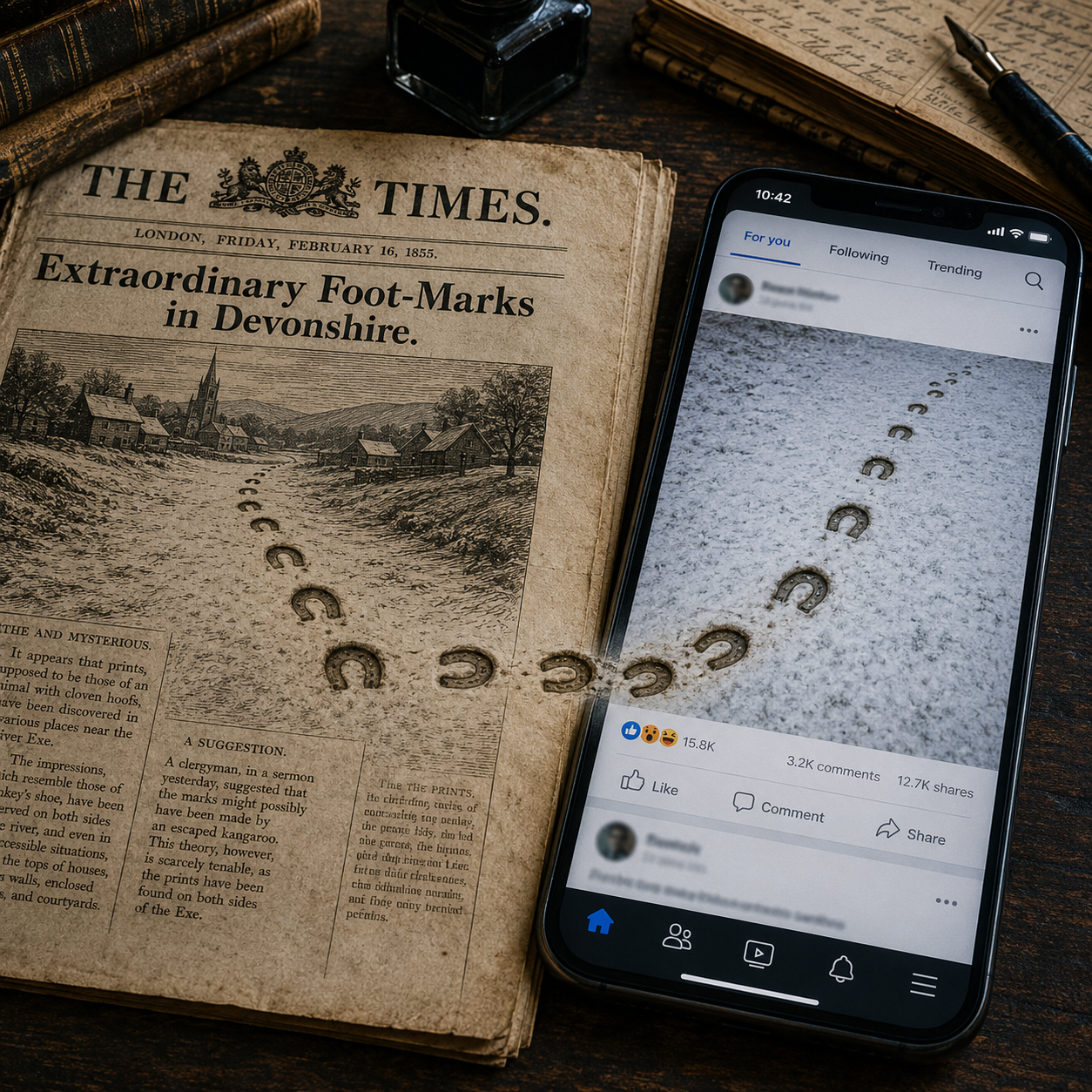
The actual account ran in the Times of London on February 16, 1855, more than a week after the snow fell. It named five towns along the Exe estuary: Topsham, Lympstone, Exmouth, Teignmouth, and Dawlish. Not thirty villages. Five. The prints it described measured an inch and a half to two and a half inches wide, spaced about eight inches apart, closely resembling the shape of a donkey’s shoe. The February 16 report really says the marks appeared in “inaccessible places,” including tops of houses and narrow walls, enclosed gardens and courtyards. Nobody wrote a hundred miles. Nobody mentioned Dorset, or Lincolnshire, or a two-mile crossing of the Exe. Those details arrived later, decades later, added one telling at a time by writers who never went near the original account.
So if you believed my first paragraph, it’s worth sitting with why.
The Times piece itself is oddly restrained for a story that would eventually get called the Devil’s own visit to England. A local vicar suggested from the pulpit that the tracks might belong to an escaped kangaroo. The paper noted, almost dismissively, that the theory couldn’t hold up, since the prints were found on both sides of the river. That’s a newspaper pushing back on its own town’s favorite explanation, in real time, in 1855. It’s not the credulous relic you might expect.
The mileage came from somewhere else entirely. In 1890, thirty-five years after the original snowfall, a writer named R.H. Busk published a letter in Notes and Queries. It was a Victorian journal for antiquarians and collectors of odd trivia. Busk had gathered secondhand reports, people who’d heard about the tracks from people who’d heard about them from someone else. He folded in sightings from Totnes, Torquay, Weymouth in Dorset, and Lincolnshire. Five towns on one estuary became a countywide, then a cross-county, phenomenon. Busk wasn’t lying. He was collecting, the way any enthusiast collects, and every story he added felt true enough to include.
That’s the quieter half of how this works. Nobody sets out to invent a bigger mystery. Someone hears a good story, remembers a slightly better version of it, and passes that one along instead. Multiply that by several decades and dozens of retellings. Five towns in Devon turn into a hundred miles of devil tracks, with no one person responsible for the lie, because there wasn’t one liar. There were a hundred and seventy years of people making the story a little more interesting than the one they’d heard.
The modern version does something different, and it’s the part that should actually worry you. Scroll through enough paranormal blogs and video essays on this case, and you’ll find the hoofprints climbing drainpipes as narrow as four inches, single file, defying explanation. You’ll find the two-mile river crossing described in vivid, confident detail, as though someone stood there and watched it happen. None of that is in the Times account. It shows up in twentieth and twenty-first century writeups, written by people chasing engagement in a media economy that rewards the more dramatic version every single time. Busk was an enthusiast padding a story he loved. A lot of what you read today is closer to a business model.
I’ve built entire episodes and articles on stories exactly like this one. So have you, if you’ve ever repeated a headline, you skimmed but never opened or shared a claim because it fit what you already believed about the world. I opened this piece by doing it to you on purpose, because telling you the mechanism exists is never as convincing as watching it happen to you directly. That’s not a confession. It’s the reason I don’t publish a claim in any of my books without a bibliography behind it. The trick only works once if you’re not willing to show your own sources the moment after you’ve used them.
So here’s what I’d ask you to take from Devon, more than the footprints themselves. The next strange headline you read today, the one that feels too vivid, too specific, too perfectly disturbing to be an accident, deserves a second look. Ask where it actually came from before you pass it along. Not because you’re gullible. In 1855, a whole county of reasonably intelligent, skeptical people did the exact same thing you just did reading this.
Maybe we’ll never know what left those tracks across Devon that night. That mystery may be beyond us. What isn’t beyond us is finding out what people actually reported in 1855 and separating it from everything the story collected afterward. Somewhere along the way, we stopped doing that. We became more interested in repeating the mystery than finding out how much of it was ever true.
Leave a Reply