The Mystery Was Manufactured
I spent this past weekend at NC Crypticon, working a booth where I was selling books and talking up our 4Ever Paranormal podcast. Between signing books, answering questions about cryptids, and talking about folklore, the conversation kept drifting back to the same stretch of ocean. Different people. Different ages. The same mystery. The same question kept finding me anyway. What do you think about the Bermuda Triangle? People asked it the way you’d ask about something they already half knew the answer to. Ships vanish there. Planes disappear. Nobody’s ever explained why.
Almost everything they repeated had been passed from one person to the next for decades, and very little of it held up anymore.
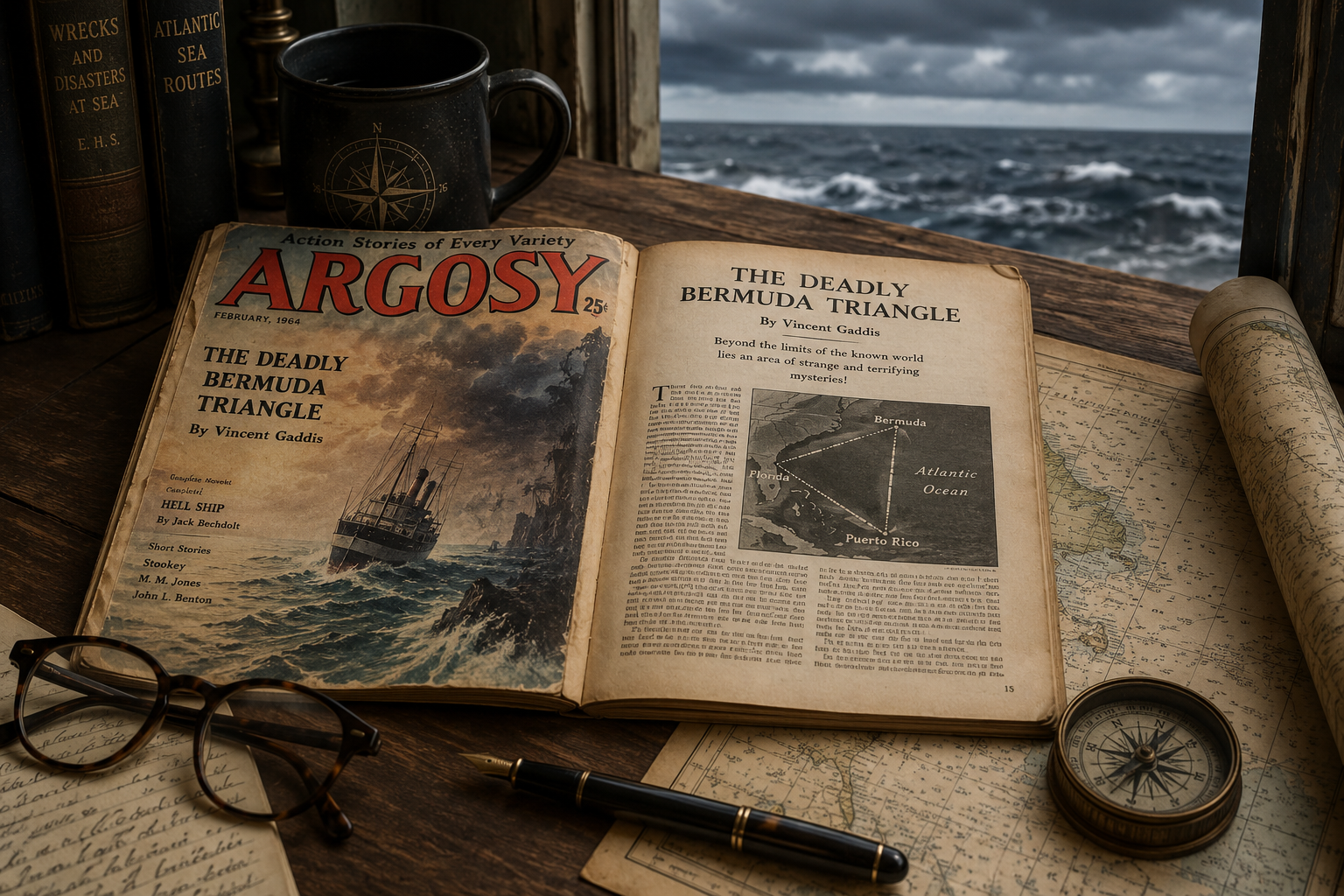
The Bermuda Triangle as we know it started with one man and one magazine. In February of 1964, a writer named Vincent Gaddis published an article in Argosy called The Deadly Bermuda Triangle. He gave the region its name, its shape, and its reputation, all in a few thousand words of pulp prose. A decade later, Charles Berlitz took Gaddis’ idea and ran further with it, adding Atlantis and vanished civilizations into a book that sold millions of copies. Between the two of them, they built a legend most people still believe without ever having read a word either man wrote.
Here’s what neither man’s version mentions. When a British television crew later asked Lloyd’s of London whether the Bermuda Triangle actually sank more ships than anywhere else, the answer was no. Lloyd’s does not charge higher insurance rates to pass through it. The United States Coast Guard’s own records back that up. The area is simply one of the busiest stretches of ocean and sky on the planet, which means more traffic, and more traffic means more accidents. Nothing about the math requires a mystery.
Meanwhile, only a few hours’ drive from where I live, a stretch of North Carolina coastline has quietly outdone the Bermuda Triangle by every measure that matters. It’s called the Graveyard of the Atlantic, and it has swallowed an estimated five thousand ships since the sixteenth century, more than two thousand of them documented and confirmed. Storms, shifting shoals, powerful currents, and centuries of heavy maritime traffic turned North Carolina’s Outer Banks into one of the most dangerous coastlines in the world. It earned its reputation the old-fashioned way. Bermuda’s own waters, by comparison, hold around three hundred known wrecks. David Stick wrote a whole book about it back in 1952, still in print, still respected. It just never got the Hollywood treatment or the paperback mythology the Triangle did. The Gulf Stream colliding with the Labrador Current explains it well enough, and explanations without mystery rarely make good television.
I told the people who asked me at Crypticon something I’ve come to believe after years of circling this material without ever making it my main focus. The Bermuda Triangle is mostly legend. It doesn’t hold up to a close look, and it never really did.
But legend surviving a fact check isn’t unique to the ocean. Ask anyone about Loch Ness and most will describe a long neck rising out of dark water, the same image that has represented the monster since 1934. That photograph was confessed to be a fake in 1994, staged with a toy submarine and a sculpted head. Sixty years passed between the hoax and the confession, and it hasn’t mattered. The photo still runs beside nearly every article written about Loch Ness today. Being proven false has never been enough to erase a good story.
That’s the part that stays with me longer than any triangle or any lake. The stories themselves almost become secondary. What fascinates me is watching an idea harden into accepted truth, even after the evidence beneath it begins to crumble. Something becomes a fact, in the way people actually use the word, once it’s been repeated enough times by enough sources. Whether it’s true stops being the deciding factor.
That doesn’t mean every unusual idea deserves to be dismissed. Separating bad evidence from unanswered questions is part of the job too.
There’s one piece of this I won’t hand you a tidy answer on. Sanderson wrote of twelve vile vortices scattered evenly around the globe, the Bermuda Triangle among them, and mapped together they trace the corners of an icosahedron. Later writers layered in ley lines and earth energy onto his grid, though Sanderson’s own explanation stayed closer to electromagnetism and colliding currents. I’ve said before that I think something in that bigger geometry is worth paying attention to. I don’t have a clean way to prove it, and I’m not going to pretend I do.
So the Bermuda Triangle probably isn’t the mystery you were told it was. What’s harder to walk away from is the question the whole thing leaves behind. If one magazine article could create a legend that survived sixty years of investigation and fact-checking, how many other “facts” do we accept simply because we’ve heard them repeated often enough?
Leave a Reply