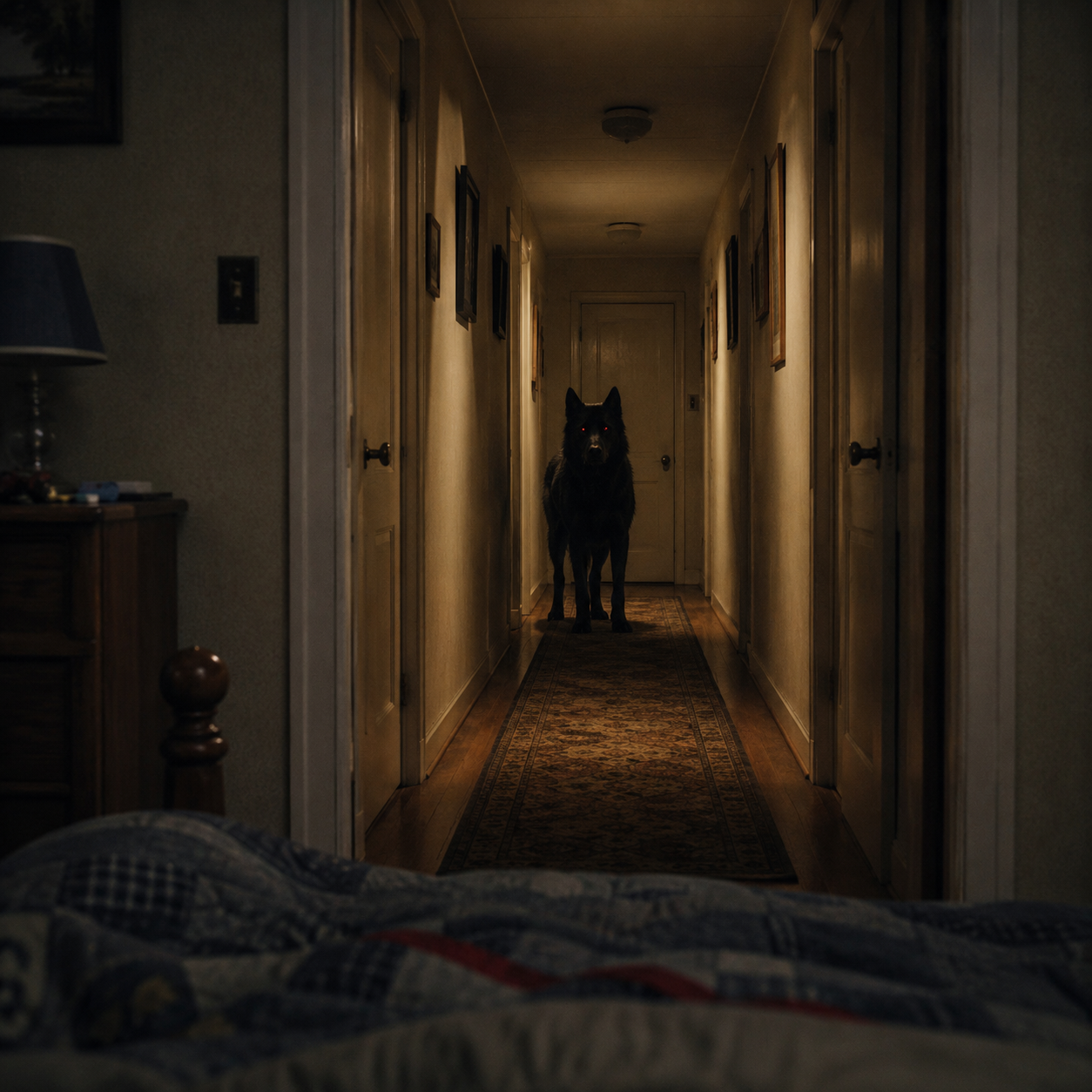
The Black Dog with Red Eyes Coming Down the Hall
I don’t remember exactly how old I was. I only remember the dog that night.
My bed looked straight down the hall in our house. It was walking from the far end of the hallway towards my bedroom. It was black with red eyes. Smoke was coming from its nose. I screamed, waking my brother and my parents who came running. I told them what I saw and that the dog was smoking a cigarette because that was the closest thing my young mind could compare it to. Cigarettes were very common at that time.
I was told it was a dream and to go back to sleep.
Sixty years later, I’m still not sure.
I can look back now and tell you this is where it all started. What interests me isn’t whether the dog was real. What interests me is what happened afterward. For whatever reason, that night seemed to start a fascination with things most people prefer not to think about. Monsters. Witches. Demons. Ghosts. The darker corners of folklore. While other children outgrew those stories, I became fascinated with them.
Looking back, I realize it wasn’t fear that held my attention. It was the questions. Why do people tell these stories? Why do the same creatures appear in different places and different cultures? Why do some legends survive for centuries while others disappear within a generation? Most of all, why are we so quick to decide we already know what something is?
Like most kids of my generation, I grew up watching monster movies. Dracula was my favorite. The Creature from the Black Lagoon was a close second. The Wolf Man wasn’t far behind. At the time, I probably enjoyed them for the same reason every kid enjoys monster movies. They were exciting. They were scary. They were different from ordinary life.
Years later, I found myself looking at those stories differently. The Creature wasn’t hunting people because he was evil. He was defending the only world he had ever known after falling for the beautiful woman. The Wolf Man wasn’t a monster by choice. He was a man trapped by something he couldn’t control. Even Dracula became something different when I sat down and read the novel. Beneath the horror was a story about loss, devotion, and the lengths someone might go to for a love they could not let go.
That realization followed me beyond monster movies. The same pattern appeared in folklore, religion, and history. Witches were not always the villains of the story. Demons were not always described the same way from one culture to another. Even figures that entire societies labeled evil often became more complicated when I looked beyond the popular version and into the older sources.
Over time, I began to notice something else. Most people are perfectly comfortable with monsters as long as they remain safely inside a story. The vampire belongs in the movie. The witch belongs in the fairy tale. The demon belongs in a book. Once those subjects move into history, folklore, religion, or personal experience, people suddenly become uncomfortable. The questions stop being entertaining and start becoming personal.
I think that’s because monsters are rarely just monsters. They become containers for our fears. Sometimes they represent the unknown. Sometimes they represent outsiders. Sometimes they represent things we do not understand well enough to explain. The details change from one generation to the next, but the process remains remarkably similar.
Consider how often we use the language of monsters in everyday life. We call people monsters. We describe ideas as dangerous. We warn our children about things we fear. Entire groups have been labeled evil throughout history, often by people who never took the time to understand them. The label frequently comes before the investigation.
That doesn’t mean monsters aren’t real. It doesn’t mean evil doesn’t exist. History provides plenty of examples of both cruelty and genuine danger. But somewhere along the way, the question stopped being whether the danger was real. It became whether I had actually looked, or just accepted what I was told to see. That’s the discipline I ended up building a life around. Not doubt for its own sake, but the habit of getting close enough to check.
Sometimes the answer is simple. Sometimes the monster is exactly what everyone believes it to be. Other times the story only changes once you go looking for who told it first, and why. The witch becomes a healer once you read the trial record instead of the town’s memory of it. The heretic becomes a reformer once you read what he actually wrote. The villain becomes a tragic figure once someone bothers to ask what he lost. The frightening thing at the edge of the firelight turns out to be a story someone needed for a reason nobody wrote down.
Most of what I’ve studied over the years eventually gives something up. A trial record. An old letter. A name behind a legend. Enough to turn a rumor into a person, or a monster into a motive. That’s the part I never got tired of, the moment a story stops being flat and turns into something you can actually stand inside.
As for the black dog with red eyes walking down the hallway, I still don’t know what happened that night. Maybe it was a dream. Maybe it was something that occurred in the strange space between sleeping and waking. Maybe there is an explanation I simply haven’t considered. Just maybe it was an omen.
What mattered was the question it left behind.
Because somewhere between a black dog in a hallway, a creature in a lagoon, a vampire searching for lost love, and a lifetime spent chasing strange stories, I learned something.
Monsters are rarely as simple as they first appear.
Leave a Reply