How Witch-Hunters Turned Ordinary People into the Devil’s Scapegoats
The version most of us inherited is compact. Salem, 1692. A few frightened accusers, a brief collective madness, then sanity returned. What that version omits is the machinery underneath. These trials ran for centuries across two continents and were not accidents. They had procedure, specialists, and budgets. They had theological frameworks constructed specifically to make the killing feel righteous.
The details belong to history. The mechanisms do not. The witch trials were not simply about superstition. They were about fear, certainty, social pressure, and institutions that rewarded accusation. Those forces did not disappear when the trials ended. They only found new ways to operate.
What follows are five facts that complicate the comfortable story considerably.
Witch-Pricking Was a Paying Profession
The premise was built on theology. When a person made a pact with the Devil, Satan left a mark on the skin. A patch of flesh that would not bleed when pierced, would not register pain. Find that mark, and you had your proof.
Professional witch-prickers traveled from village to village carrying long needles and offering their services. Payment was typically tied to results. The more witches identified, the more they earned. The incentive was not justice. It was volume.
Many carried retractable needles, designed to collapse on contact and simulate a painless prick without breaking skin. The accused would be stripped in front of witnesses, examined for hours, and the result recorded as binding evidence. The fraud was built into the instrument itself.
One of the more documented cases is Christian Caddell, who called herself John Dickson, operating in Scotland during the witch panic of the 1660s. She worked the countryside as a licensed pricker, charging per confirmed witch, until her identity was exposed and she was arrested. The people she had identified before that were already dead.
Spectral Evidence Was Admissible in Court
At Salem in 1692, a witness could testify that the accused’s spirit had appeared to them in a dream and caused them harm. That testimony was treated as evidence. There was nothing to examine, nothing to cross-examine. Only the accuser had witnessed the specter, and the court accepted their account as fact.
The reasoning was theological rather than arbitrary. Witch-hunters and religious authorities held that Satan could dispatch a witch’s spirit independently of her body, meaning a specter in someone’s dream was a real supernatural event. The belief had doctrinal architecture behind it, built over generations. It was also a system with no floor. Once accepted, it created a category of accusation that was by definition impossible to disprove. The accused had no mechanism of defense.
The courts eventually abandoned spectral evidence. By then it had done considerable work.
The Malleus Maleficarum Gave Persecution a Legal Procedure
Heinrich Kramer had already conducted witch trials before he wrote the manual. His 1485 trial in Innsbruck had been repudiated by local clergy, who denounced his methods as improper and exaggerated. Undeterred, Kramer returned to Germany and began compiling the text that would become the Malleus Maleficarum, published in 1487.
The book ran to three sections. The first established the theological reality of witchcraft, drawing on scripture to argue that witches were not misguided people but active agents of the Devil. The second described how to identify them. The third outlined legal procedure for prosecution and sentencing. It was a complete system, from accusation to execution, wrapped in the authority of the Dominican order.
Its central argument about women was explicit. Female witches were the primary threat. Women were more susceptible to temptation, more easily corrupted, more naturally drawn toward evil. The book targeted midwives, healers, widows, women who lived outside conventional social structures. These were people already on the margins. The Malleus gave courts a righteous reason to eliminate them.
Matthew Hopkins Built an Empire Out of Chaos
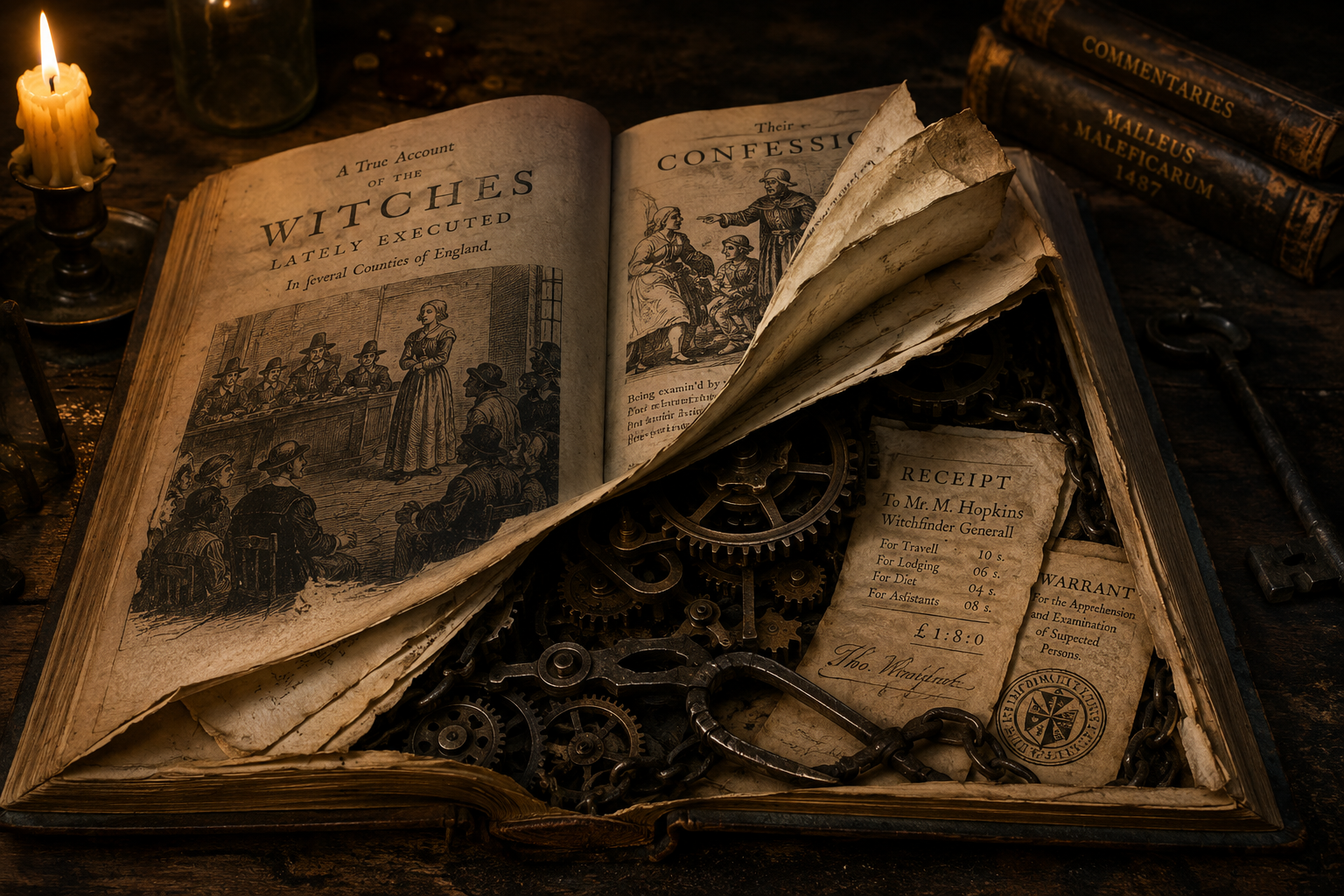
Matthew Hopkins was born around 1620 in Suffolk, the son of a Puritan minister. He had no formal legal training, no official appointment, no sanctioned authority of any kind. What he had was ambition and an instinct for exploiting fear.
The English Civil War created the conditions he needed. Central authority had fractured. Local courts were improvising. Communities were frightened and looking for explanations. Hopkins emerged from that environment and declared himself Witchfinder General, a title entirely of his own invention.
Towns hired him anyway. He moved across eastern England conducting investigations, overseeing interrogations, and charging substantial fees for his services. He billed for travel, lodging, meals, and assistants. His methods stayed just outside the formal legal definition of torture, but not by much. Sleep deprivation was a favored tool. Witch-pricking, using retractable needles that simulated the discovery of a Devil’s mark, was another.
Hopkins became one of the most infamous figures in a witch panic that ultimately claimed an estimated forty to sixty thousand lives across Europe. Hopkins himself died in 1647, likely of tuberculosis, before any accounting. His methods had already crossed the Atlantic by then.
The Psychological Torture Was Designed to Leave No Evidence
The rack left marks. Sleep deprivation did not. Guards worked in rotating shifts, ordered to keep prisoners awake for days, waiting for exhaustion to accomplish what cruder instruments would have done more visibly. Under sustained pressure without sleep, people confessed to flying to sabbats, to pacts with demons, to naming neighbors they had known their whole lives.
The authorities who deployed these methods understood, practically if not consciously, that breaking a person’s sense of reality was more efficient than breaking their body. Physical torture left scars that could be seen. Psychological collapse looked, to a courtroom, indistinguishable from guilt.
Many of the accused were elderly, poor, or mentally unwell. Their confusion under questioning did not register as confusion. It registered as confirmation. The confessions extracted this way were then used to fuel further accusations, setting a cycle in motion that communities had no mechanism to stop once it had started.
These five facts are not the whole story. They are a way in. The full account, the tribunals, the theology, the people who built the machine and the people it destroyed, is what Heretics of the Harvest Moon: The True Story of the Witch Trials covers. It is a history of how ordinary communities became instruments of mass killing, and what it means that the pattern keeps finding new forms.
Leave a Reply