Then Died from a Bug?
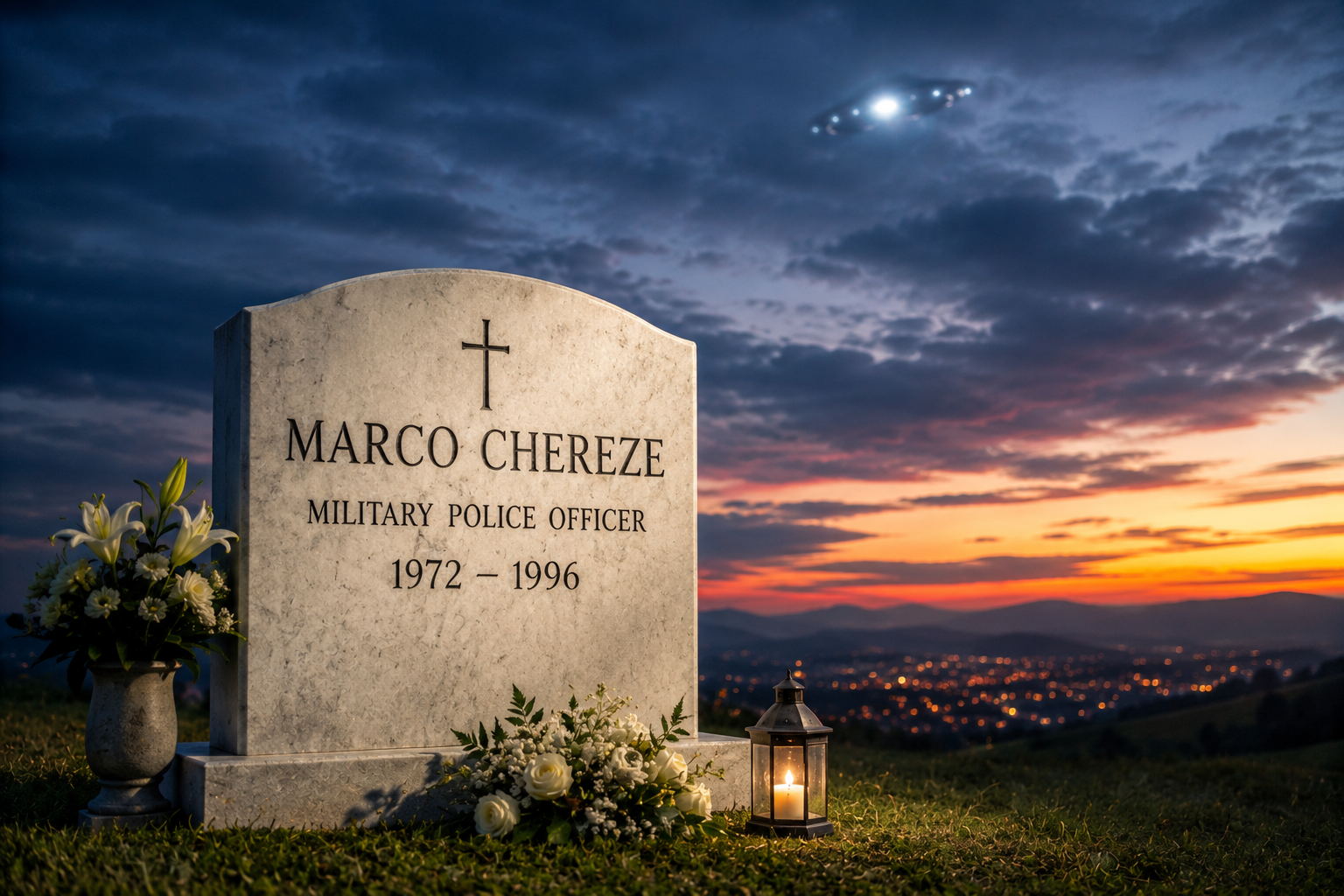
Marco Chereze was twenty-three years old and doing his job. A Military police officer, on a January night, a road just outside Varginha in southeastern Brazil. A creature ran in front of his patrol car. He got out and grabbed it with his bare hands.
Within weeks he was dead.
His family said he had no prior ailments. No surgical history. Nothing. The official explanation from the 24th Battalion of the Varginha military police was that he had gone into the hospital to have a cyst removed and contracted a severe infection during recovery. His sister told a different story. She said he came home from that night covered in a sticky, foul-smelling substance he couldn’t wash off. Sulfur and ammonia. A scratch on his skin from the creature that wouldn’t heal. An infection that spread and didn’t respond to anything, and kept getting worse over weeks, until it killed him.
Two stories. One family. One dead twenty-three-year-old.
Decide for yourself which one sounds like the truth.
I first heard about Varginha a little different than most people outside Brazil hear about it. Not from a documentary or a headline. From family. Our daughter-in-law is Brazilian, and one evening she mentioned it the way you mention something that everyone back home already knows. A crash. Creatures. The military. The cover story that insulted everyone who heard it. She wasn’t trying to convince us of anything. She was describing something that had been part of the cultural conversation her entire life. A case that Brazilians of a certain age carry the way Americans carry Roswell, except with more witnesses, more institutional involvement, and considerably less resolution. I’ve been following it ever since. The more you pull on it, the less it lets go.
Thirty years after that January night, on January 20th, 2026, filmmaker James Fox stood at the National Press Club in Washington, D.C. and asked the United States government a direct question. He framed it carefully and on the record. The 1996 Varginha incident, he stated, involved dozens of firsthand accounts of UAP contact and direct encounter with living non-human beings. They were, according to multiple Brazilian witnesses, flown out of Brazil to the United States. Recently, Brazil’s former Minister of Defense Aldo Rebelo confirmed the incident had occurred. His position was straightforward: if the U.S. disclosed what it had, Brazil would do the same.
That is not a UFO enthusiast making a claim on a podcast. That is a diplomatic statement from a Brazilian former minister of defense, confirmed on the record. This was used as the foundation for a formal request at one of the most respected journalism venues in the country. Alongside Fox stood Congressman Eric Burlison, a member of the House Oversight Committee, who told the room he had been informed about the Varginha case through an FBI report. He told reporters that agencies and contractors know that Congress knows the records exist, and that they intend to get them released.
This is where Varginha sits in 2026. Not in the fringe. On the steps.
To understand why any of this matters, you have to go back to January 1996. And you have to be willing to sit with the fact that what happened there has never been adequately explained, by anyone, on either side.
Varginha is a city of roughly 100,000 people in the state of Minas Gerais. Coffee country. Rolling hills. Not the kind of place that ends up in congressional testimony. On January 13th, 1996, the United States Air Force reportedly informed the Brazilian government that they were tracking an unidentified craft off the coast. They said they had shot it down.
That same evening, a man named Carlos de Sousa described watching a craft about the size of a small school bus, shaped like a submarine, struggling to maintain altitude. It had white smoke coming from a tear in its side. He thought it was a plane in trouble and followed it in his car. At the crash site he found thin metallic debris scattered across a field. He picked up a piece, crumpled it in his fist, opened his hand, and watched it return to its original shape. The smell was sulfur and ammonia. Within minutes the military arrived and ordered him to leave at gunpoint. Shortly after that, men in a dark vehicle with no license plates pulled up to him at a gas station, knew his name, knew his address, knew his family. They told him to stay quiet.
De Sousa gave one interview that night. Then he said nothing publicly for nearly three decades.
Seven days later, on January 20th, three young women were cutting through a vacant lot in a residential neighborhood about six miles from the crash site. Liliane Silva was fourteen. Her sister Valquíria was sixteen. Their friend Katia Xavier was twenty-one. They passed within eight feet of a creature crouched near a wall. Brown, oily skin. Red eyes, three times the size of a human’s, with no visible pupils. No hair. A small slit where a mouth might be. A sad expression, according to Katia. A frightened one, according to Valquíria.
“It was an exchange of fears,” Valquíria said. “It was afraid of us in the same way we were afraid of it.”
Liliane screamed. They ran. They slowed as they got closer to the Silva house, asking each other what they had just seen. When they got inside they told their mother they had seen a demon. They were raised Catholic, and at that moment, that was the only word they had for it.
Their mother Luiza made them take her back to the spot, against their will. The creature was gone. Left behind were a footprint in the dirt and a smell that Luiza later said stayed inside her nose for twenty days, no matter what she tried. The girls’ account has not changed by a single detail in thirty years.
What was happening in the streets of Varginha while those girls were running home did not become clear until later, pieced together from civilian and military witnesses. The military had established a cordon in the same residential neighborhood. The fire department, which operates under military control in Brazil, had reportedly recovered a creature from a nearby embankment earlier in the day and transported it to Humanitas Hospital. The city was not under lockdown, exactly. But the machinery of containment was already running.
Then Marco Chereze rounded a corner in his patrol car, and what he encountered ran in front of him, and he got out and grabbed it.
Whatever that creature was, it went to the same hospital. And so, eventually, did Chereze. Not in the way he expected.
A military whistleblower, identified only as Military X in James Fox’s documentary Moment of Contact, described being involved in transporting a body from Humanitas Hospital to an army base approximately forty kilometers away. He described a stainless-steel table. Doctors. People with clipboards. Something with oily, silicone-like skin. A foot shaped like a V. Everyone in the room, he said, looked scared of it. A soldier stood filming with a camera. Military X said that when he saw the foot, he knew what he was looking at wasn’t human.
A former Brazilian Air Force traffic controller told Fox that a U.S. Air Force aircraft landed unannounced at Campinas and dispatched two helicopters, which collected something and departed. According to civilian and military witnesses on the ground, American agents took the bodies and the crash debris.
That detail is not peripheral. It is the entire reason Varginha is now a subject of congressional inquiry rather than a footnote in a documentary about a Brazilian UFO incident.
Here is what the Brazilian government officially said happened.
The creature the three girls saw was a local man known as Mudinho. He was around thirty years old, reportedly had a mental disorder, and liked to crouch in the same position the girls described. He was dirty because it had rained. The military vehicles in the streets were there because the trucks were still under warranty and needed maintenance at the local dealership. The bodies seen at Humanitas Hospital were a couple with dwarfism who had come to deliver a baby. And Marco Chereze, the officer who died weeks after capturing a creature, had simply gone in for a cyst removal and picked up an infection.
Read that again slowly. Take each one on its own terms.
A man crouching in a vacant lot, dirty from rain, was mistaken by three young women for a creature with red eyes three times the size of a human’s, oily skin, and no visible mouth. Military vehicles were in the streets for dealership maintenance. And a healthy twenty-three-year-old policeman died from a routine surgical complication that his family and colleagues had no prior knowledge of.
You don’t have to believe in aliens to find those explanations insufficient. You just have to be paying attention.
The case didn’t stay buried. It never really could. Civilian UFO investigator Vitório Pacaccini described being shown a thirty-five-second film fragment of one of the creatures in 2012, still alive, making a sound like a bee. Brown skin, oily. A large head with red eyes and three raised knobs along the top. He eventually had to relocate to Italy. He cited death threats.
UFO researcher Patricia Fernandes Silva described being pulled into an hours-long interrogation by the former sheriff of Varginha in 2014, questioned about her relationship to the case despite having never investigated it. At the end, after he sent the other officers out of the room, he showed her a color photograph printed on Kodak paper. Two creatures. One dead. One crouched in exactly the position the three girls had described. The sheriff told her his hands had been paralyzed ever since he grabbed one of the creatures by the legs. She watched him struggle to pull the photograph from the newspaper he kept it in, his hands cupped, stiff, barely working.
He had been carrying that photograph for eighteen years.
What changed in 2026 wasn’t the evidence. The witnesses have been consistent. The accounts have held. What changed is the political context surrounding them.
David Grusch, a fourteen-year Air Force veteran and former intelligence officer who became a federal whistleblower, testified under oath to Congress that he was informed of a multi-decade UAP crash retrieval and reverse engineering programs, to which he was denied access. He said he spoke with colleagues who knew of recovered non-human craft and biological material. Kirk McConnell, who spent decades on congressional intelligence and defense committees, stated at the National Press Club that he was present in classified settings. Some were when highly credible sources briefed senators, including Marco Rubio, about recovered nonhuman bodies. His argument was precise: legitimate national security concerns might justify keeping advanced technology classified. But that justification, he said, does not extend to biological evidence of another life form.
Congressman Burlison put it more plainly. For decades, he said, the American people have been treated like children. Told there are government secrets they simply don’t get to know. He called the information being passed to his office a Tom Clancy-style dead drop. He called for President Trump to waive all nondisclosure agreements for UAP whistleblowers. Representative Anna Paulina Luna joined the call for immunity, to allow those with direct knowledge of recovery programs to come forward without consequence.
And here is the detail that sits quietly behind all of it: Fox spent nine months working with an immigration lawyer and a sitting congressman to get six Brazilian witnesses into the United States to testify in person. All six were denied visas.
Six people who say they were there. Denied entry. No explanation offered that held up under scrutiny.
Marco Chereze has been dead for thirty years. He was twenty-three. He had a family. He had a sister who still tells a different story than the one the military gave.
Whatever he grabbed on that January night, whatever scratched him, whatever left that smell on his skin that wouldn’t wash off, the Brazilian government says it was nothing. A cyst. A hospital bug. Routine.
Somewhere in a classified archive, if the witnesses are right, there is documentation of what was recovered in Varginha in January 1996. There are records of what arrived at an American military installation. There may be film. There may be biological material still under study. The declassified Brazilian military documents now publicly available confirm the government had a formalized UFO tracking system dating back to at least 1971. With confidential questionnaires, classified correspondence, and a formal Military Police Inquiry running to thousands of pages.
The paper exists. The question is whether the people holding it will ever let the rest of us read it.
Brazil’s former Minister of Defense says if the U.S. moves, Brazil will follow. Congress has the request. The witnesses have given their testimony. Some of them have been carrying this for thirty years, waiting for someone with enough authority to ask the right question in the right room.
The room has been found. The question has been asked.
Now we wait for the answer.
Leave a Reply