Why perception, not evidence, is often what shapes the outcome
A woman named Alicia Maxey was found severely injured on a rural property in Blanco, Oklahoma. No one could immediately explain what caused it. The person who discovered her was an EMT. The injuries were serious enough that authorities brought in wildlife officials to determine what kind of animal could have caused them.
At that point, the case was still grounded in what could be observed. The injuries. The scene. The need to identify a source.
Then there was her account.
She told family members she heard a deep growl just before the attack. Not a clear identification. Not a confirmed source. Just a sound that stood out in the moment before everything changed.
That detail doesn’t solve the case. It doesn’t identify what attacked her. But it changes how the case is understood.
It introduces the moment where fear begins to shape perception. And once that happens, the case stops being about what occurred and starts being shaped by what people think it means.
I’ve spent a lot of time looking at cases where that line blurred. Not just paranormal claims, but situations where something felt off enough that people began filling in the gaps. Fear gets treated like fact. Belief gets treated like proof. And once that process starts, it doesn’t stay contained. It influences how events are remembered, how suspects are viewed, and sometimes how outcomes are decided.
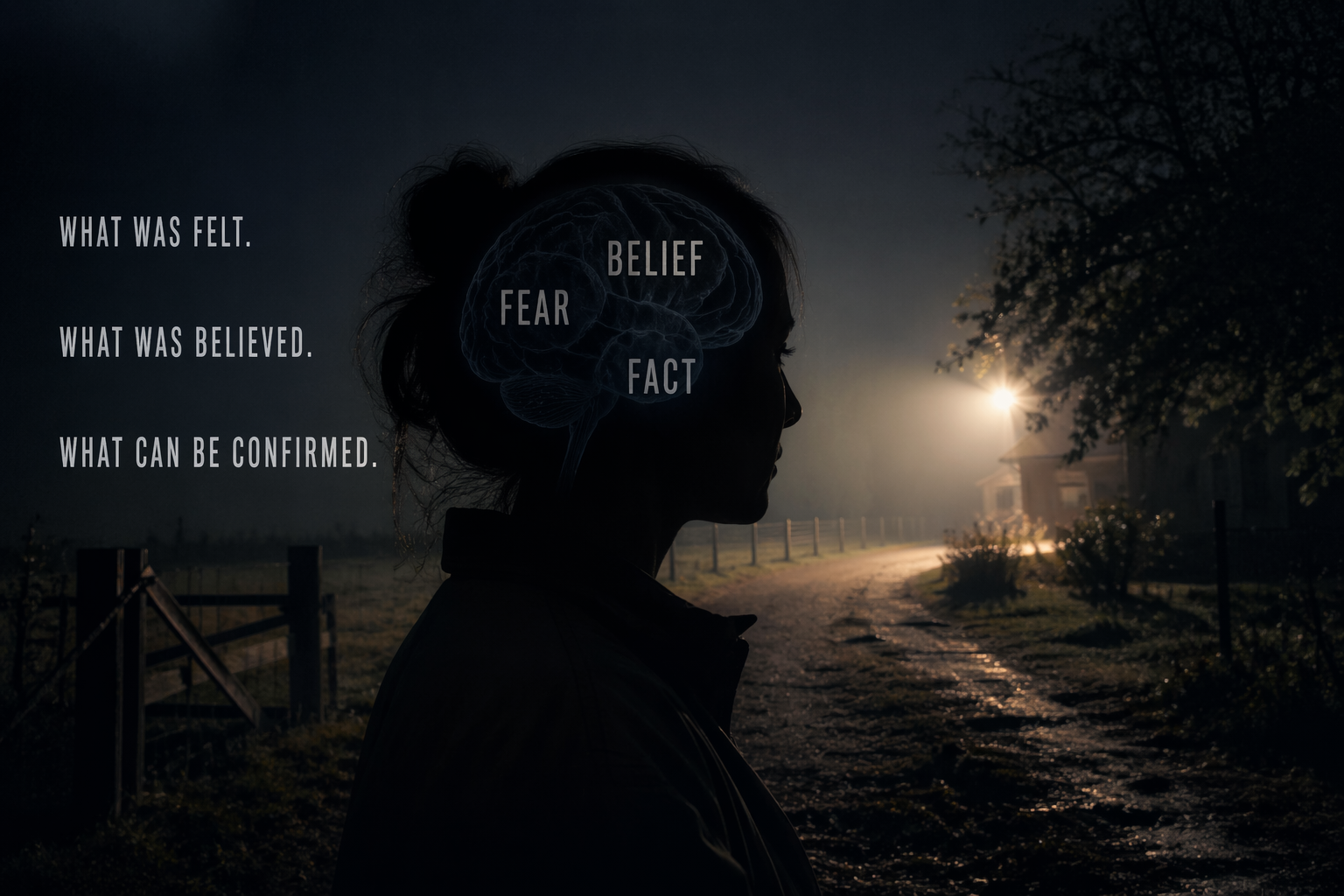
Most of us don’t have a clear way to separate three things that feel identical in the moment but behave very differently under pressure: fear, belief, and fact.
If you can separate them, even roughly, the case changes. Not because the unknown disappears, but because it stops controlling the direction of the story.
Start with fear.
Fear is immediate. It doesn’t wait for confirmation. It fills in gaps before you even realize there are gaps to fill.
In an unexplained situation, fear narrows focus. It allows our brain to amplify certain details and pushes others out. A sound becomes louder than it was. Movement feels closer than it actually is. Time stretches or compresses in ways that make later recall unreliable.
None of that means the person is wrong. It means their perception is being shaped in real time by stress.
If you don’t account for that, you end up treating a reaction as if it were a recording.
So the first step is simple in theory and difficult in practice: isolate what was experienced from how it was felt. What was actually seen or heard, and what did it feel like in that moment. Those are not the same thing, even if they arrive together.
Then move to belief.
Belief comes after the initial moment, even if it feels immediate. It’s the attempt to explain what just happened.
This is where the mind starts organizing the experience into something that makes sense. If the event doesn’t fit an existing explanation, belief steps in to bridge that gap. Sometimes it pulls from cultural ideas. Sometimes from personal history. Sometimes from whatever explanation feels closest to the emotional weight of the moment.
Once that belief forms, it begins to shape everything that follows.
Memories adjust around it. Details that support it become clearer. Details that don’t start to fade or get reinterpreted. Conversations reinforce it. Questions begin to assume it.
Again, this doesn’t make it false. It makes it influential.
If you don’t separate belief from the original experience, you end up analyzing the explanation instead of the event.
Then there’s fact.
Fact is the part everyone claims to focus on, but it’s usually the hardest to hold onto.
Facts don’t expand to fill gaps. They can’t be manipulated to match a narrative. They are what they are, often incomplete and many times frustratingly limited.
Physical evidence. Timelines. Verified actions. Things that can be checked independently of how anyone felt about them.
The problem is that facts rarely arrive in a complete set. There are always missing pieces. And those gaps are exactly where fear and belief start to bleed back in.
That’s why separating these three matters.
Not to dismiss the experience. Not to strip meaning out of it. But to keep each part from distorting the others.
When you can look at a case and say:
This is what was felt.
This is what was believed.
And this is what can be confirmed.
You start to see the structure underneath the story.
And once you see that, the case changes.
Not because the unknown disappears, but because it stops controlling how everything else is interpreted.
Most people don’t think about separating these layers until they have to.
It’s easy to read a case from a distance and assume the facts will speak for themselves. That evidence will stay clean. That perception doesn’t get in the way.
But it does.
Not just in extreme cases. In everyday situations. In moments where something feels off, where the explanation isn’t immediate, where the mind starts trying to close the gap before the information is there.
That’s where fear enters first.
Then belief follows.
And fact, if it isn’t held carefully, gets pulled along with them.
Once you see that pattern, it’s hard to unsee.
You start to notice it in how stories are told. By how quickly conclusions can be formed. And by how often people defend their conclusion before the full picture exists.
And you start to realize something uncomfortable.
The unknown isn’t what complicates most cases.
It’s how we respond to it And once that response takes hold, the outcome often follows.
Leave a Reply