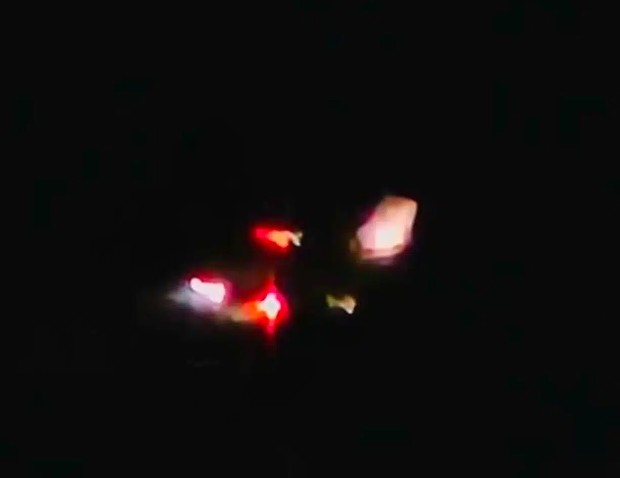
December 2023, Langley Air Force Base. This is one of the most controlled pieces of airspace in the United States, home to F-22 Raptors and layered surveillance systems designed to detect and respond to threats quickly. It is not the kind of place where repeated activity goes unnoticed, and it is not a place where you expect hesitation once something is identified.
For seventeen nights, they came back.
Not one or two. Sometimes dozens. Up to forty at a time, moving across the base in the same steady pattern. Witnesses described them spaced out, following each other, each one carrying that same reddish-orange light. There was nothing random about it. Observations determined this was clearly planned.
The assumption most people would make is that something like this would be handled quickly. Identify the source, disrupt the signal, or remove the drones from the airspace. That expectation runs into a reality most people do not consider. These bases exist within domestic airspace, often near civilian populations. Any decision to engage a target carries consequences beyond the target itself. Where debris falls matters. They couldn’t just shoot them down. This was domestic airspace, with civilian areas close enough to matter. There were attempts to disrupt the signal, but they didn’t hold. The drones stayed in the air and kept moving.
So it kept happening.
They were seeing them. Tracking them. Watching the same thing play out night after night, and it just…continued. That’s the part that sticks. Not that something showed up once, but that it came back and nothing really changed.
If it had stopped there, maybe it gets buried as a one-off. Something noticed, something fixed, and then it disappears.
It didn’t stop there.
In March 2026, Barksdale Air Force Base reported a similar pattern. There is major concern over this one as this is the headquarters of Air Force Global Strike Command, which manages the Air Force’s nuclear mission. This time the number was smaller, roughly twelve to fifteen drones, but the behavior was more focused. These were not commercial units. They weren’t just passing over open ground either. They were moving over the flight line, over areas you would expect to be locked down tighter than that, and they stayed there for days.
They tried to interfere with them. That part matters. It just didn’t change anything. The drones kept moving, same pattern, same control. Whatever was running them wasn’t using anything simple.
Later on, an internal report confirmed what that already suggested. These were long-range systems, built with a level of control you don’t usually see outside of something intentional.
At that point, the range of explanations narrows, but the problem does not. The most grounded conclusion is that these systems are human-built and human-operated. That should make the situation easier to understand, but it introduces a more difficult question. If these are conventional systems, then they represent a capability that can repeatedly access restricted military airspace without being effectively countered in real time.
The response from the military reflects that concern. There’s a response coming. New counter-drone systems, faster deployment tools, radar upgrades focused on low-altitude targets that have been slipping through.
You don’t build that unless something got through first.
There is a stated timeline for broader deployment within roughly a year, which indicates that this is being treated as an active and ongoing issue rather than a closed one.
What sits underneath all of this is not speculation about what the drones are, but recognition of what they exposed. For a sustained period of time, there was a functional gap in how that airspace could be protected against small, coordinated systems. The drones were not invisible. They were not ignored. They were present, tracked, and still able to continue operating within that space.
Air superiority inside U.S. borders is rarely questioned. It’s taken for granted. What happened here doesn’t undo that, but it does show there are limits to it, and those limits are closer than most people would expect.
And that leads to a question that doesn’t stay contained to drones.
If repeated, observable incursions by human-built systems can operate over military installations like this and continue without immediate resolution, then the assumption that everything is understood in real time starts to shift. Not dramatically at first, but enough to make you stop and look at it differently.
The conversation around unidentified aerial phenomena usually begins from a fixed position. That the answers already exist, and the only issue is whether those answers are being shared. That clarity is there, somewhere behind closed doors, waiting to be disclosed.
What these incidents suggest is something less settled than that.
Not everything is resolved when it happens. Not everything is fully understood in the moment. There are limits to response, limits to visibility, and limits to how quickly something can be identified and controlled, even when it is right in front of you.
And if something as concrete and human as a coordinated drone swarm can move through restricted airspace and remain active without immediate resolution, then it becomes harder to assume that everything else in the sky is already accounted for, already explained, or simply being held back.
Maybe it is not just a question of disclosure.
Maybe the expectation of full disclosure assumes a level of control and understanding that does not fully exist.
Leave a Reply