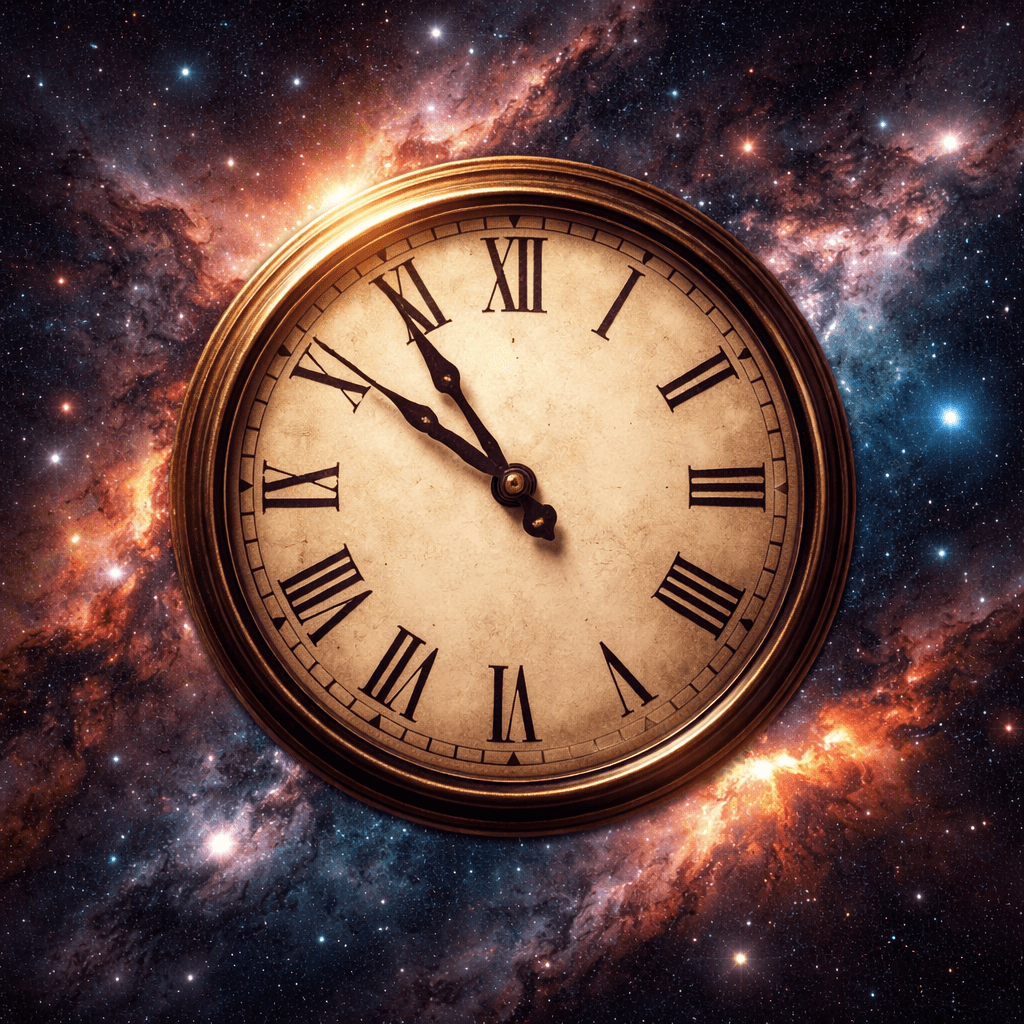
And Other Things We Tell Ourselves
Previously published on Medium.
I don’t believe time exists the way we think it does.
Not as a force moving forward. Not as a river carrying us from past to future. What we call time feels more like a mental scaffold. Something we built to keep change from overwhelming us.
The universe doesn’t need clocks.
There is no cosmic past or future ticking away somewhere beyond our reach. There are only processes. Cycles. Rearrangements of matter and energy that don’t care about sequence the way we do. Stars form, burn, collapse, and seed new matter. Galaxies rotate. Atoms vibrate. Energy shifts states. None of this requires minutes or years. It requires motion.
Time appears only when a conscious mind starts counting the change and then forgets it’s the one doing the counting.
That realization is uncomfortable because time is how we make ourselves matter. It gives us beginnings and endings. Progress. Achievement. Legacy. Without time, those ideas thin out fast.
We like to say we exist in time. But it may be more accurate to say we are occurring.
A wave doesn’t move through the ocean the way it thinks it does. The wave is a temporary shape formed by motion already present. It rises, crests, and dissolves, believing it had a beginning and an end. But the ocean never experienced the wave as a separate event. Only the wave did, because it was briefly aware of itself.
That awareness is what we call consciousness. And consciousness demands narrative.
Narrative creates meaning. Meaning creates stability. Stability keeps us functional. But narrative also lies to us gently. It centers us. It tells us the universe is unfolding in a way that tracks our lives, our clocks, our plans.
Cycles don’t offer that courtesy.
Cycles don’t care about progress. They don’t privilege beginnings or endings. They don’t preserve what passes through them. They simply continue.
Even physics, when followed honestly, starts pulling the rug out from under time. Relativity shows that time stretches and compresses depending on motion and gravity. Something that bends is not a substance. It’s a relationship. A comparison between events. A bookkeeping system, not a thing flowing through reality.
The universe isn’t moving forward.
It’s reconfiguring.
And we’re brief patterns within that reconfiguration, convinced we’re traveling somewhere because our awareness is narrow enough to experience sequence.
This also changes how creation itself is understood. A creator “outside of time” doesn’t mean something that existed before everything else. That idea already assumes time is fundamental. It suggests instead something not bound by sequence at all. Creation wouldn’t be a single event. It would be an ongoing condition.
Not “let there be.”
“There is.”
That idea surfaces again and again in mysticism, across cultures that otherwise disagree about almost everything. Eternal now. Ever-present source. Breath. Pulse. Different metaphors circling the same problem. How do you describe existence without slicing it into before and after?
The real discomfort comes next.
If time isn’t fundamental, then control is mostly an illusion. We don’t manage our place in the universe. We don’t direct its movement. We briefly participate in patterns already in motion and tell ourselves stories about purpose to make that participation bearable.
We don’t control time.
We experience change and name it so we don’t panic at impermanence.
That thought can feel nihilistic if you expect the universe to care about you personally. But it doesn’t erase meaning. It just relocates it.
Meaning isn’t granted by duration.
It isn’t stored in legacy.
It isn’t guaranteed by narrative.
It exists in the fact that a pattern became aware of itself at all.
We are small. Temporary. Unrepeatable.
One drop in an ocean that does not stop moving for any single wave.
But the drop is made of the same substance as the ocean.
And once you see that clearly, time stops looking like a master we’re racing against and starts looking like a story we tell ourselves while something much larger continues, indifferent to whether we’re watching or not.
 WJ Brendle
Leave a comment