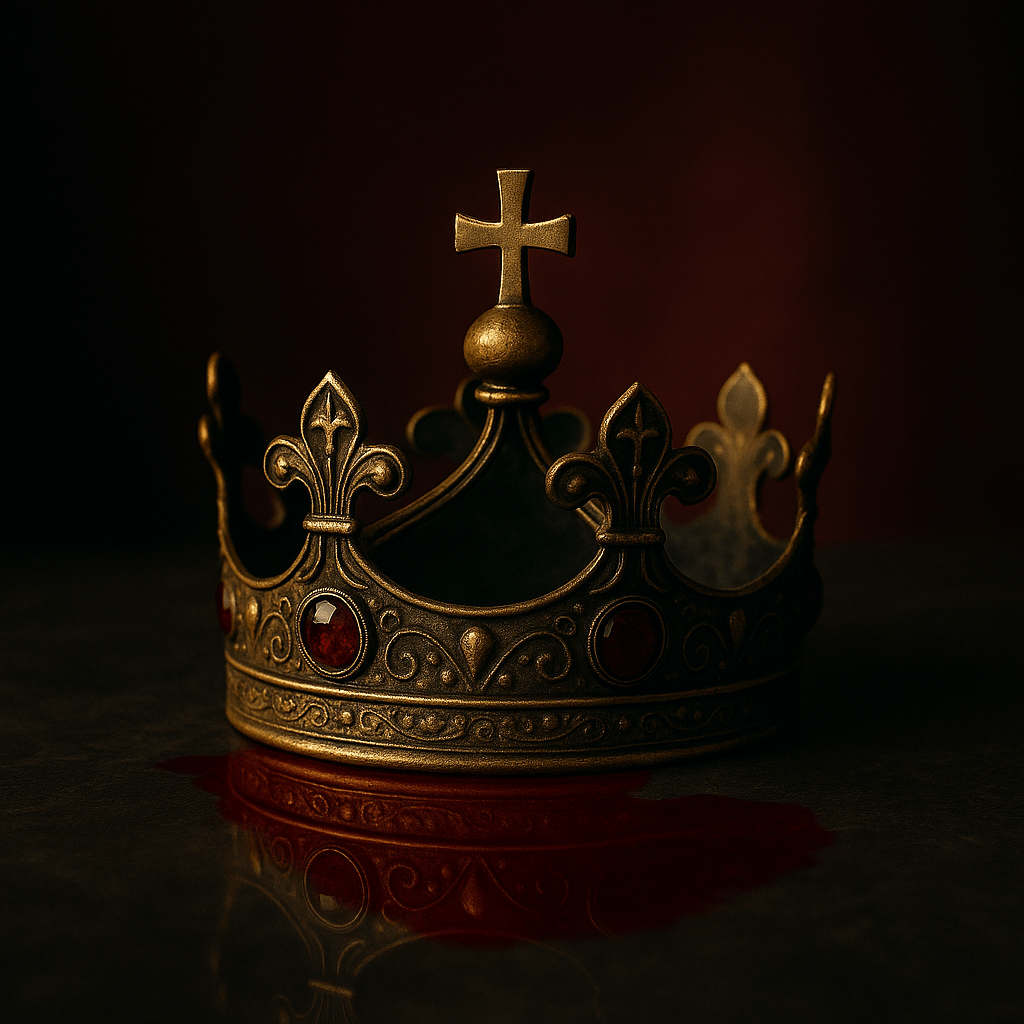
History, myth, and modern science keep meeting in the same shadow—the idea that power and immortality share the same bloodline.
The Living Hunger
Every generation finds its own way to chase immortality. The technology may be cleaner now, but the obsession is the same. Stem-cell transfusions, blood-plasma exchanges, entire labs promising to turn back time—all sold under the polished name of “longevity science.” The price, of course, is for the elite. But scratch the surface and the dream reveals its old shape: life stolen, extended, or borrowed from someone else’s veins.
Long before the six-figure infusions, people whispered that royal families already held the secret—hidden, as always, in their blood.
A Prince Called the Dragon
“That secret in the fifteenth century was wearing armor.” Vlad III, also known as Vlad the Impaler, Prince of Wallachia, was born into the Order of the Dragon, an order of knighthood founded to protect Christianity from the Ottoman Turks.
The symbol of the order was “the coiled serpent eating its own tail, which represented “bravery, fidelity, perhaps even selflessness.” However, “later interpretations decode the symbol in more profound ways—a self-consuming serpent, feeding on its own flesh, its strength fed by its own decay.”
His contemporaries admired Vlad for his brilliance, brutality, and terrifying efficiency. The German and Saxon broadsheets, or propaganda literature, existed side by side with the account of the meal eaten by Vlad among the impaled bodies. Whether or not he actually dipped bread in the victims’ blood is of little consequence. The symbol had taken hold, the notion that power was sustained by sacrifice.
The Order and the Shadow
The Order of the Dragon was no secret society. It was politics in plate armor. Yet, centuries later, occultists breathed fresh meaning into the Order’s emblem. “Dragon” came to signify forbidden knowledge, the serpent that guards paradise. The Order was seen as the last spark of the mystery schools. “Dracul” ceased to be “soldier of Christ” but “initiate of the secret fire.”
The change in meaning is why the legend of Vlad lived on long after his empire lay in ruins. Vlad was not hailed as a diligent defender of borders. He was the one who went beyond the line from human to legend.
The Vampire Becomes a Count
Four centuries later, Bram Stoker formalized the line with his own work of literature. Dracula was the product of Stoker’s own involvement with Theosophists, Freemasons, and the members of the Hermetic Order of the Golden Dawn, who orbited throughout London society. Whether Stoker packed these ideas inside his novel or simply breathed the same air, his work remains the reflection of those who mattered to the period, the fears of the age taking the form of Dracula: illness, sex, the foreign noble who drains the national vital force from its citizens’ bodies.
The vampire, who had once dwelled in the graveyard, was now an aristocrat in Stoker’s reworking of the mythology. The eternal life that had once cursed the peasants was now the birthright of the elite.
A Royal Genealogy and a Persistent Rumor
A legend, you see, usually leads on to another legend, but occasionally one turns out to be the truth.
In 2017, newspapers revived an old claim that the British royal family were descendants of Vlad the Impaler. The connection leads to Queen Mary of Teck, the grandmother of Queen Elizabeth II, who had an ancestor from Transylvania, the noblewoman Countess Claudine Rhedey de Kis-Rhede, tracing her lineage from the Basarab dynasty, the same one from which Vlad the Impaler and his half-brother, Vlad the Mon descended.
What genealogists freely acknowledge is the trail becomes murky beyond the fifteenth century. Nonetheless, the legend persists, because, well, it just makes more sense that way. Of course, the modern crown feels it must trace back to the Dragon’s son and not his half-brother. When it comes to royals, power is hereditary. So, in typical humanistic fashion, myth fills in whatever history forgets.
King Charles III, for instance, enjoys jokingly, “I am, of course, a distant relation of Vlad the Impaler,” in his efforts to promote Transylvanian conservation projects. Tourism is indeed the ideal alchemy, transforming lineage into products!
The Blood Countess
A century after Vlad, another noble found her name buried under the same stain—too much blood. Countess Elizabeth Bathory of Ecsed (1560–1614) ruled vast Hungarian estates. When her servants began to vanish, the rumors turned monstrous. By her trial, she stood accused of killing scores of girls. A servant’s story inflated the number to six hundred fifty and claimed she bathed in their blood to preserve her youth.
The official records mention cruelty and imprisonment, but no ritual bathing. Yet the myth survived because it answered the question no court could: how far would the privileged go to stay beautiful and in control? Bathory’s legend became the mirror of Dracula’s—different gender, same hunger.
The Immortal Alchemist
Then came the Count of St. Germain—violinist, diplomat, chemist, maybe spy, definitely strange. He dazzled the courts of eighteenth-century Europe, claimed to transmute metals, and appeared ageless. He died in 1784, or so they say. Decades later, witnesses swore they’d seen him again. By the nineteenth century, occult revivals made him a saint of Theosophy—the man who never dies.
Legend says that by the twentieth century he’d crossed the Atlantic. In New Orleans, he reappeared as Jacques St. Germain, the eternal nobleman who poured “wine mixed with blood.” The story’s pure folklore, but its longevity proves something simple: we don’t want monsters to die. We want them to mingle.
The Science of Youth
Fast forward to now. Wealthy investors quietly fund anti-aging start-ups exploring plasma transfusions from the young. The lab results are mixed; the ethics, louder. The language, though, hasn’t changed—it’s still about taking life from another body. In glossy brochures, “donors” replace “victims.” The chalice becomes a centrifuge.
We laugh off vampires but accept rejuvenation science without blinking. It’s the same fantasy with better lighting. Every new invention invites the old myth to unpack its coffin again.
Blood, Power, and the Need for Belief
Why do these stories cling to royalty, billionaires, and secret orders? Because blood is both symbol and evidence. It proves lineage—and it’s the one thing we all lose. When the powerful seem eternal—when kings, CEOs, or influencers outlast every storm—we fall back on the old explanation: they must be feeding on something we can’t have.
History repeats the theme. The Order of the Dragon defended faith with blood. The Golden Dawn sought enlightenment through sacrifice. Today’s elite chase immortality through biochemistry. Different uniforms, same ritual. Someone’s life is always the cost.
The Dragon’s Lesson
None of this needs a literal vampire. The myth endures because it captures a human truth—we still trade one person’s blood for another’s comfort. Vlad, Bathory, St. Germain, the royals, the researchers—they form a chain of the same desire. Each century refines the method but keeps the offering.
We tell these stories to warn ourselves, but maybe also because we envy them. The line between horror and longing is thinner than the vein that carries life itself.
So when you hear a monarch trace their blood back to the Dragon, or read about the rich experimenting with young blood, remember—we’ve been here before. The technology changes. The myth never does. Power always wants eternity. And eternity always demands blood.
Author’s Note
This essay was researched and written entirely by the author. Editorial tools such as ChatGPT-5 and ProWritingAid were used for fact-checking, language refinement, and clarity—under my full direction and authorship. These tools functioned only as editorial support, never as creative originators. All interpretations, ideas, and conclusions remain my own.
 WJ Brendle
Leave a comment