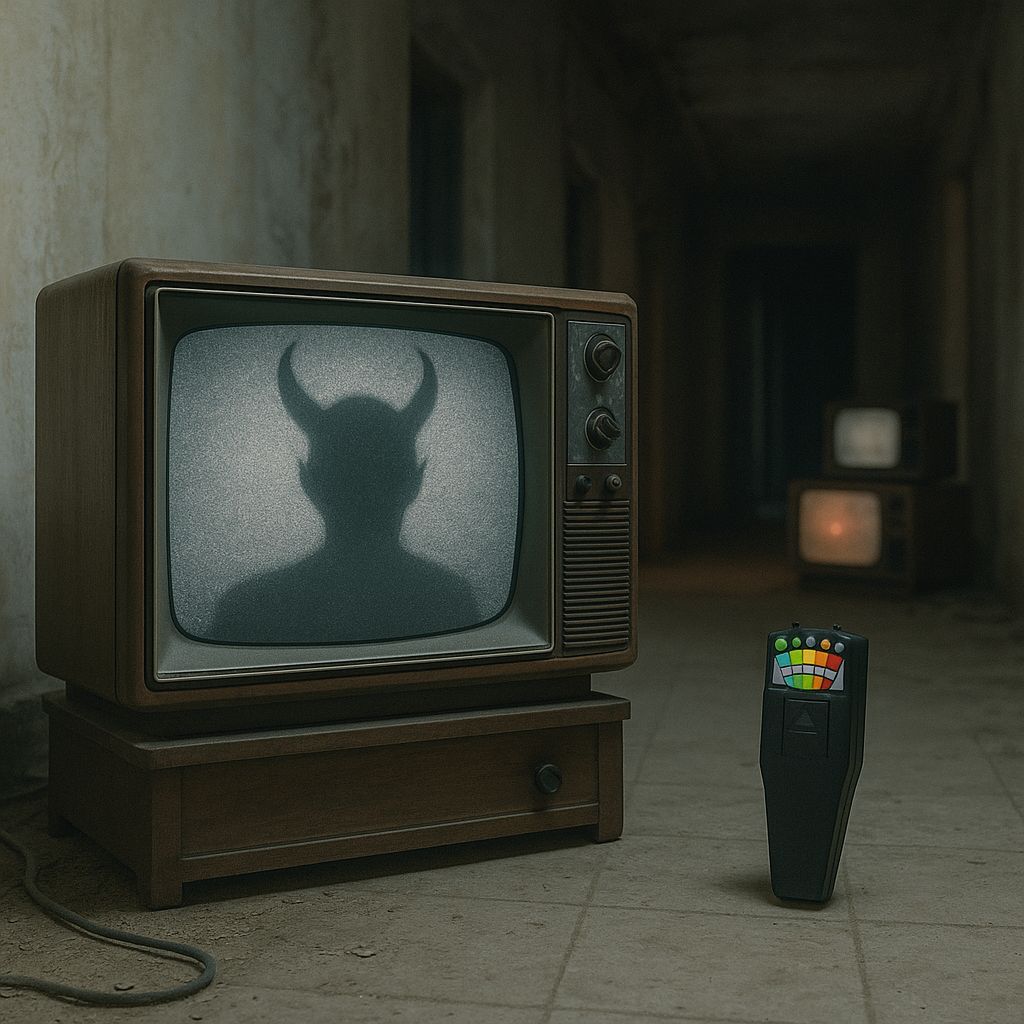
The demon theme has become more and more common in today’s paranormal investigations. And more and more locations and ghost hunts are now thought to be demonic. The perception change is most evident with ghost hunting television programs and YouTube paranormal channels, where investigators are likely to explain unexplained events as demons. But this phenomenon questions whether our capability to identify and diagnose evidence for a demonic haunting has increased, or whether it is simply a cultural fad with numerous investigators jumping on the demonic bandwagon.
A few decades ago, ghost sightings tended to be attributed to more traditional entities, such as headless horsemen and phantom coaches. However, as these historical references become less relevant, have our perception and preconceptions been shaped by current cultural trends? Today, we’re more likely to describe unexplained phenomena as dark shadowy figures, monks, or demons, all of which are commonly sighted ghosts. According to an 1890 survey on ghost sightings, things were very different. The survey, featured in Usborne’s ‘The World Of The Unknown: Ghosts’, revealed that at the end of the 19th century, around two-thirds of those who could describe a ghost they’d seen said it was a ghost of someone who is currently living, rather than a dead person. These ‘ghosts of the living’ were believed to be some kind of unexplained telepathic phenomenon, rather than spirits. They may have even witnessed a doppelganger.
In our podcast 4 Ever Paranormal, in Episode 62, we discussed 30 East Drive in Pontefract, also known as the Black Monk House. It seems this tale has undergone a significant shift in interpretation. For decades, this case was understood to be the result of a very violent poltergeist, but in recent years, it’s been rebranded as a demon or negative entity. The house is said to be haunted by a monk who murdered a local girl, which some might argue is evil enough in itself. However, the paranormal investigators at locations like 30 East Drive are convinced that they’re dealing with demons, and it’s not just a matter of labeling activity as demonic for the sake of entertainment. Could the newer concept of poltergeist activity common from someone within the household be driving this?
The rise of demonic encounters can be attributed, in part, to the influence of paranormal television shows. These programs often start with a disclaimer stating that they’re for entertainment purposes only, but the lines between reality and fiction can become blurred. In the world of entertainment, there are trends in storytelling and concepts, and demons are currently the latest trend. One of the major culprits behind this surge in demon claims is Zak Bagans, who has brought the concept of demons to a mainstream audience in his show ‘Ghost Adventures’ and in his documentary film ‘Demon House’. Amongst the many demons Zak and his team have encountered in the show’s recent history is Zozo, an ancient demon said to make himself known to those who dabble with contacting spirits, especially via a Ouija board. We covered the Latoya Ammons case of the “Demon House” in Episode 61 while we covered Zozo in Episode 84.
Zozo’s rise to prominence is a prime example of how paranormal television can create a trend that spreads across the paranormal world. In recent years, there’s been an increase in reports of Zozo coming forward in séances, with 2018 being a particularly busy year for the evil entity. Zak’s show has also popularized the idea of dybbuk boxes, which were previously unknown to the general public. We did a deep dive into the origins of this particular dybbuk box in Episodes 19 and 25. A dybbuk box is said to be a container that houses a malevolent spirit, and Zak’s Las Vegas occult museum now has one on display, which is housed in a protective case to prevent any negative energy from escaping.
The concept of demons is often shrouded in mystery and conflicting theories. Some believe that there are negative or malevolent spirits that will sometimes lie or pretend to be demons to make themselves appear more terrifying. Others claim that demons will pretend to be less scary spirits, such as the ghost of an innocent young girl, in order to trick their victims. This means that it’s impossible to know for certain whether you’ve really made contact with a real demon. The idea of demons is rooted in various religious beliefs, from fallen angels in the Christian faith to jinns in the Islamic faith.
The most rational explanation for demons is that they’re spirits from a lower realm that have never had a corporeal life and are therefore young souls. Many believe that spirits exist in realms and progress to a higher realm after each corporeal life. However, demons are said to be able to choose to come to our reality in order to experience their first corporeal life and learn the basic lessons this life can teach them. Because they are young and have not yet learned the moral and ethical rules of life, they can be malevolent in nature. This theory is relatively new and has more holes in it and holds about as much water as a screen door on a submarine.
It’s also said that demons will draw on negative energy, which is more common in the modern human world, to give them the strength to move a step closer to taking corporeal form. But not all demons are malevolent if called upon correctly. Just read the Lesser Key of Solomon.
Those who believe in demons theorize they are only able to enter our plane by invitation, which can happen through badly conducted séances, use of a Ouija board, or by using a demon’s name. However, this is nothing more than speculation, and the truth is that we know nothing about demons and there’s no solid proof that they even exist. Despite the lack of evidence, the concept of demons continues to captivate the public imagination, and it’s clear that this trend is here to stay for the foreseeable future.
So, is the increase of demonic activity all in out minds and television shows or is it a result of the world’s increasing state of secularism?
 WJ Brendle
Leave a comment